 SENSE INSIDER Personal Finance, Smart Investing, Passive Income and Side Hustle & Budgeting Tips
You open your mail and find a letter from a company you’ve never heard of, claiming you owe $1,400 on a credit card you barely remember. Or maybe your phone keeps ringing from an unknown number, and when you answer, someone on the other end starts talking about a debt that supposedly went to collections years ago.
Your first instinct might be to pay just to make it stop. Don’t — at least not yet.
Here’s the thing: the moment you pay a collection agency without understanding the full picture, you could be restarting a legal clock, paying a debt you don’t actually owe, or handing money to a company that has no legitimate right to collect from you. The debt collection industry is one of the most heavily regulated spaces in consumer finance, and that regulation exists specifically to protect you.
In this guide, we’ll walk through everything you need to know before you hand over a single dollar including your legal rights, how to find out what you actually owe, and smarter ways to handle collectors that can save you money and protect your credit.
What Is a Collection Agency, and How Did They Get Your Debt?
When a creditor i mean a credit card company, a medical provider, a lender decides they’re unlikely to collect what you owe, they have two options. They can hire a third-party collection agency to pursue the debt on their behalf (and pay them a percentage of whatever they recover), or they can sell the debt outright to a debt buyer, often for just a few cents on the dollar.
That second scenario is where things get complicated.
Debt buyers purchase old debts in bulk, sometimes paying as little as 3–7 cents per dollar of face value. They then try to collect the full amount from consumers which is completely legal but it also means the company calling you has a very different financial relationship to that debt than your original lender did. They paid almost nothing for it. Any amount you pay is nearly all profit for them.
This is important context for everything that follows, because it shapes why you have real negotiating power, why mistakes and fraud are common in this industry, and why knowing your rights changes the whole equation.
The Real Reason You Should Never Pay a Collection Agency Without Checking First
The title of this article isn’t meant to suggest you should simply ignore all debts forever. Rather, it’s a warning: never pay reflexively, without verifying the debt first. Here’s why that matters so much.
The Debt Might Be Past the Statute of Limitations
Every type of debt has a statute of limitations like a window of time during which a creditor or collector can legally sue you to collect. Once that window closes, the debt becomes what’s called a “time-barred debt.” You may still technically owe the money in a moral sense, but the collector has lost their most powerful legal tool: the ability to take you to court.
The statute of limitations varies by state and debt type, but typically ranges from 3 to 6 years in most US states. In the UK, it’s generally 6 years (5 in Scotland). In Canada, it’s 2 years in most provinces. In Australia, it’s typically 6 years.
Here’s the critical part: making a payment on a time-barred debt can restart the statute of limitations in many states. You could inadvertently hand the collector a fresh legal window to sue you — over a debt that was previously unenforceable.
It Might Not Be Your Debt
Debt collection errors are alarmingly common. The Federal Trade Commission (FTC) has found that a significant portion of consumer complaints about debt collectors involve debts that were already paid, debts that belong to someone else with a similar name, debts that were discharged in bankruptcy, or amounts that were inflated or fabricated.
Before you pay anything, you have the legal right to demand written verification of the debt.
Paying the Wrong Collector Could Be Useless
Debts are sometimes sold multiple times, passed between different collection companies. If you pay an agency that no longer owns your debt, you may not be legally discharged from the obligation and another collector could still come after you for the same balance.
Your Rights Under Debt Collection Laws
This is where you need to pay close attention, because the law is firmly on your side.
The Fair Debt Collection Practices Act (FDCPA) — USA
In the United States, the Fair Debt Collection Practices Act is the main federal law governing how third-party debt collectors can behave. Under the FDCPA:
Collectors cannot: call you before 8 a.m. or after 9 p.m. in your time zone, contact you at work if you’ve told them your employer prohibits it, use threatening or abusive language, misrepresent the amount you owe, threaten legal action they don’t intend to take, or contact third parties about your debt (with limited exceptions).
You have the right to: request written verification of the debt, dispute the debt in writing, demand that the collector stop contacting you entirely (though this doesn’t make the debt go away), and sue collectors who violate the FDCPA — with the right to recover damages and legal fees.
The validation right is the most powerful tool for most people. When a collector first contacts you, they’re required to send a written validation notice within 5 days. If you send a written dispute within 30 days of receiving that notice, they must cease collection activity until they provide verification.
Similar Protections in the UK, Canada, and Australia
UK: The Financial Conduct Authority (FCA) regulates debt collection firms. Collectors must follow the FCA’s Consumer Credit Sourcebook, which prohibits harassment, misleading practices, and pressuring consumers into unaffordable repayments. You can also request that a creditor or collector stop contacting you while you get advice.
Canada: Each province has its own Collection and Debt Settlement Services Act (or equivalent). Collectors must be licensed, cannot contact you more than 3 times in 7 days without consent, and must provide written confirmation of the debt when requested.
Australia: Debt collectors must follow the Australian Securities and Investments Commission (ASIC) guidelines and the Australian Consumer Law. Contact frequency limits apply, and collectors cannot use undue harassment or coercion.
How to Find Out What You Owe in Collections
Before you can act strategically, you need a complete picture of where you actually stand. Here’s how to find out what debt collectors you owe.
Pull Your Free Credit Reports
In the US, you’re entitled to one free credit report per year from each of the three major bureaus like Equifax, Experian, and TransUnion at AnnualCreditReport.com. Any accounts in collections should appear here, including the name of the collection agency, the original creditor, and the balance reported.
In the UK, you can check your credit reports with Equifax, Experian, and TransUnion (formerly Callcredit). In Canada, Equifax and TransUnion both operate. In Australia, your report can be obtained from Equifax, illion, and Experian.
Pro tip: Check all three bureaus, not just one. Different collection agencies may report to different bureaus, and a debt might appear on one report but not another.
Request Validation from the Collector Directly
If a collector has already contacted you, send a written debt validation request by certified mail with return receipt. Under the FDCPA, they must provide proof that the debt is yours, the amount is accurate, and they have the legal right to collect it.
This letter should be sent within 30 days of first contact to trigger the legal obligation to cease collection activity while they verify. Keep copies of everything.
Review Your Own Records
Go through old bank statements, credit card statements, and any correspondence with original creditors. You may find a debt that you thought was resolved but wasn’t or one that was genuinely paid but recorded incorrectly.
How to Know If You Have Collections on Your Credit Report
Many people are surprised to discover collections they didn’t know about. Here’s what to look for when reviewing your credit report.
Collections accounts will appear in a dedicated “Collections” or “Negative Accounts” section of your credit report. Each entry will show:
- The name of the collection agency
- The name of the original creditor
- The date the account was opened with the collector
- The original balance and any current balance
- The date it was first reported as delinquent (called the “date of first delinquency” — this is key for calculating when it ages off your report)
In the US, a collection account can remain on your credit report for up to 7 years from the date of first delinquency, regardless of whether you pay it or not. Paying a collection account does not remove it from your report, it just changes the status from “unpaid” to “paid.” The negative entry still stays.
This is another major reason why simply paying without a strategy isn’t always the right move.
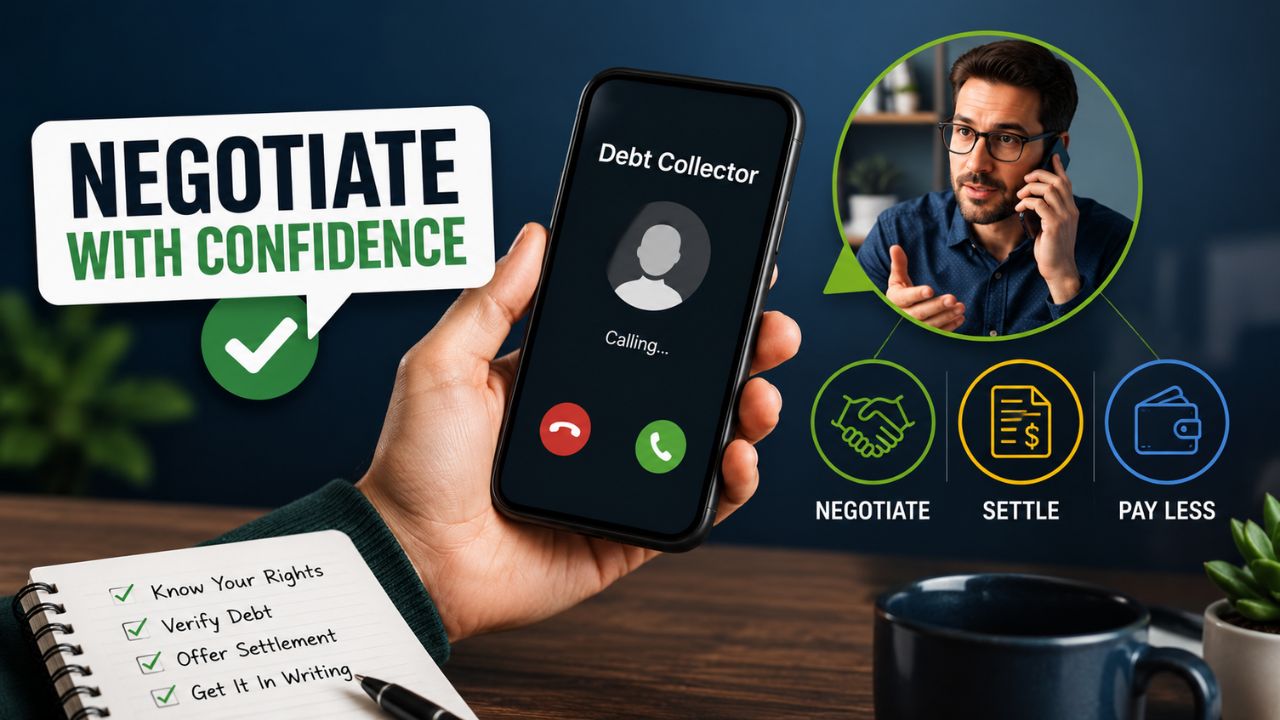
Can You Negotiate With Debt Collectors? (Yes — and Here’s How)
The short answer is yes, absolutely. Debt collectors especially debt buyers often accept significantly less than the full balance because they paid so little for the debt in the first place.
What Is Pay-for-Delete?
One negotiation strategy worth knowing about is “pay-for-delete.” This means you offer to pay the debt (or a reduced portion of it) in exchange for the collector agreeing to remove the collection entry from your credit report entirely. It’s not guaranteed, and not all collectors will agree, but it’s worth requesting.
If they agree, get it in writing before you pay a single dollar. A verbal agreement means nothing.
Negotiating a Reduced Settlement
Even if pay-for-delete isn’t available, you can often negotiate the balance down significantly. Debt buyers commonly accept settlements of 40–60% of the stated balance, and sometimes less because any recovery above what they paid for the debt is profit.
Tips for negotiating effectively:
- Start lower than your target. Offer 25% and work up from there.
- Be patient. Collectors may initially refuse — call back in a few weeks.
- Use your leverage. If the debt is near the statute of limitations, the collector knows their options are narrowing.
- Never share more financial information than necessary. You don’t need to explain your situation in detail.
- Always get any agreement in writing before paying.
Consider Getting Professional Help
If the debt is large or you’re not comfortable negotiating yourself, a nonprofit credit counseling agency can help. In the US, look for agencies accredited by the National Foundation for Credit Counseling (NFCC). In the UK, charities like StepChange and Citizens Advice offer free debt advice. In Australia, the National Debt Helpline (1800 007 007) provides free financial counseling.
Note: “debt settlement companies” are different from nonprofit counselors. Many charge high fees and can damage your credit further. Be cautious.
When Paying a Collection Agency Actually Makes Sense
We’ve covered why you should never pay impulsively. But there are situations where paying strategically is the right move.
Pay if:
- The debt is verified, legitimately yours, and within the statute of limitations
- You’re applying for a mortgage or major loan and the collection account is an obstacle
- You’ve negotiated a pay-for-delete agreement in writing
- You’ve confirmed the collector has legal standing to collect (they own the debt or have a proper assignment from the original creditor)
- You’ve received a valid court judgment against you
Don’t pay if:
- The debt is unverified and the collector won’t provide documentation
- The debt is time-barred and you live in a state/province where payment restarts the clock
- The amount is inaccurate or inflated
- You suspect the collector is fraudulent (scam collectors do exist — never pay based solely on a phone call)
Dealing With Aggressive Collectors: Your Practical Playbook
Even if you know your rights, it can be stressful when a collector won’t leave you alone. Here’s a practical approach.
Step 1 — Don’t ignore contact entirely. It won’t make the debt disappear, and ignoring a legitimate collector long enough can result in a lawsuit, wage garnishment, or bank levy.
Step 2 — Send a debt validation letter. Within 30 days of first contact, send a written request for verification by certified mail. This legally pauses collection activity.
Step 3 — Check your credit reports. Confirm the account is there, review all the details, and note the date of first delinquency.
Step 4 — Research the statute of limitations for your state/province and debt type. If it’s time-barred, consult a consumer law attorney before taking any action.
Step 5 — Decide your strategy. Pay in full, negotiate a settlement, dispute an error, or do nothing if the debt is time-barred and you don’t need it resolved for a credit application.
Step 6 — If they violate your rights, document everything. If a collector harasses you, calls at illegal hours, or makes false statements, document it. You can file complaints with the Consumer Financial Protection Bureau (CFPB) in the US, the FCA in the UK, or equivalent regulators — and you may have grounds for a lawsuit.
Managing debt well is part of building long-term financial health. If you’re also working through other debt challenges, our Debt Management & Credit section covers a range of scenarios, including our in-depth guide on how to handle negative equity on a car loan — another situation where knowing your options before acting makes all the difference.
Frequently Asked Questions
Does paying a collection account improve my credit score?
It depends. Simply paying a collection account often has a limited impact on your FICO score because the negative entry remains on your report for 7 years. However, newer credit scoring models (like FICO 9 and VantageScore 3.0 and 4.0) do treat paid collections more favorably than unpaid ones. The biggest credit score benefit comes from a pay-for-delete agreement, which removes the entry entirely.
Can a debt collector sue me?
Yes. If a debt is within the statute of limitations, a collector can file a lawsuit to obtain a judgment against you. With a judgment, they can potentially garnish wages, levy bank accounts, or place liens on property — depending on your state’s laws. Ignoring a lawsuit (even one you suspect is for an invalid debt) is one of the worst things you can do. If you’re served with legal papers, respond and consider consulting a consumer law attorney.
What’s the difference between a debt collector and a debt buyer?
A debt collector typically works on behalf of the original creditor, collecting debts for a fee or percentage. A debt buyer actually purchases the debt outright, often for pennies on the dollar, and then attempts to collect the full balance for profit. Both are regulated under the FDCPA in the US, but debt buyers often have even less documentation about the original debt — which gives you more grounds to demand verification.
How long does a collection account stay on my credit report?
In the US, a collection account stays on your credit report for 7 years from the date of first delinquency — that’s the date you first missed a payment on the original account, not the date it was sold to a collector. After 7 years, it must be removed automatically. Paying the collection does not reset this timer.
Can I dispute a collection account on my credit report?
Absolutely. If a collection account on your report is inaccurate, outdated (beyond 7 years), or belongs to someone else, you can dispute it directly with the credit bureaus. Under the Fair Credit Reporting Act (FCRA) in the US, bureaus must investigate disputes typically within 30 days. If the collector can’t verify the information, the entry must be removed.
Conclusion: Knowledge Is Your Best Defense
Getting a call from a debt collector is stressful. The combination of financial pressure and uncertainty about your legal standing is exactly what collection agencies count on — because a panicked consumer who pays without asking questions is far more profitable than one who knows their rights.
The core takeaway is this: you have real legal protections, real negotiating power, and real options that can make a significant difference in both how much you pay and how much damage the collection account does to your financial life.
Never pay reflexively. Verify the debt, check the statute of limitations, understand what payment will and won’t do for your credit, and negotiate from a position of knowledge. If the amount is large or the situation complicated, get professional advice from a nonprofit credit counselor or consumer law attorney before acting.
Debt is manageable — and so is the process of dealing with collectors — when you stop reacting out of fear and start acting with information.
Take control of your financial situation today. Browse the full Debt Management & Credit section at Sense Insider for more practical, actionable guides on getting your debt under control and rebuilding your financial footing.
Disclaimer: This article is for informational purposes only and does not constitute legal or financial advice. Laws vary by location and individual circumstances. Consult a qualified attorney or financial advisor for guidance specific to your situation.