 SENSE INSIDER Personal Finance, Smart Investing, Passive Income and Side Hustle & Budgeting Tips
You’ve spotted the car you want. Maybe it’s that sleek new electric SUV, or a practical sedan that fits your budget better as a lease than a purchase. You’re ready to walk into the dealership but then the question hits you: Is my credit score good enough to lease?
It’s a fair concern. Car dealerships and captive finance companies (the lenders tied directly to automakers) pull your credit report before approving a lease, and your score plays a big role in whether you get approved and what monthly payment you’ll end up with. The good news is that leasing isn’t just for people with perfect credit. The bad news is that going in without knowing your numbers can cost you hundreds of dollars per month.
In this guide, you’ll get the exact credit score benchmarks lenders use in 2026, how the approval tiers work, what happens if your score falls short, and practical strategies to improve your position before you walk into that showroom. Whether you’re in the US, UK, Canada, or Australia, the core principles here apply and we’ll flag any regional differences where they matter.
What Credit Score Do You Need to Lease a Car? (Quick Answer)
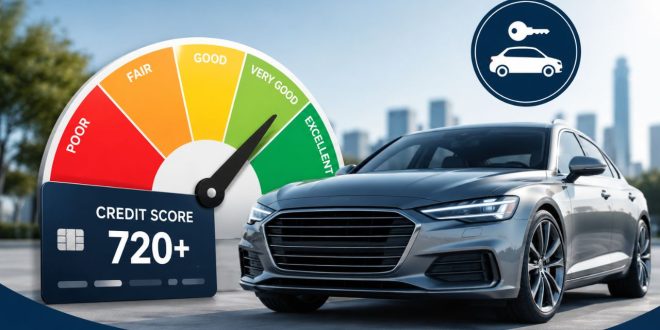
The minimum credit score needed to lease a car is typically 620–660 (FICO scale), but most dealerships and lenders prefer a score of 700 or higher. To get the best lease terms, the lowest money factor (lease equivalent of interest rate) and the most favorable residual value. You generally want a score of 720 or above.
Here’s a fast breakdown:
| Credit Tier | Score Range | Lease Approval Odds | Typical Terms |
| Super Prime | 720–850 | Very High | Best rates, lowest money factor |
| Prime | 680–719 | High | Competitive rates, standard terms |
| Near Prime | 620–679 | Moderate | Higher payments, possible security deposit |
| Subprime | 580–619 | Low | Difficult to approve; larger deposit required |
| Deep Subprime | Below 580 | Very Low | Most mainstream lenders will decline |
These ranges are based on the FICO 8 model, which is the most widely used scoring model among auto lenders in the United States. If you’re in Canada, the Equifax and TransUnion scales are similar. In the UK and Australia, scoring systems differ (the UK uses a 0–999 scale with Experian; Australia uses a similar range), but the principle remains, lenders want to see that you’re a reliable borrower before handing you the keys to a $30,000+ vehicle.
How Leasing Actually Works (And Why Your Credit Matters So Much)
Before diving deeper into the numbers, it’s worth understanding what a lease actually is because that context explains why lenders scrutinize your credit so heavily.
When you lease a car, you’re not buying it. You’re essentially paying for the depreciation the car experiences during your lease term (usually 24–48 months), plus a financing charge called the money factor. At the end of the lease, the car goes back to the dealer.
Because the automaker or finance company retains ownership throughout, they’re taking on real risk. If you default on payments and they have to repossess the vehicle, they lose money. Your credit score is their primary tool for estimating how likely that is to happen.
This is also why the lease approval process is often stricter than getting an auto loan to buy a car outright. With a purchase loan, the lender at least owns an asset they can sell to recoup losses. With a lease, the math is tighter.
The money factor is particularly important here. A borrower with a 750 credit score might receive a money factor of 0.00125 (equivalent to about 3% APR), while someone with a 620 score if approved at all, might get 0.0035 or higher. On a $35,000 vehicle, that difference can add $100–$200 to your monthly payment.
Credit Score Tiers Explained: What Each Range Means for Your Lease
Super Prime (720–850): The Sweet Spot for Leasing
If your credit score sits in this range, you’re in excellent shape. Captive lenders like Toyota Financial Services, BMW Financial Services, Ford Motor Credit, GM Financial, and others compete for borrowers like you. You’ll typically receive:
- The manufacturer’s advertised money factor with no markup
- Access to promotional lease deals (often 0% or near-0% financing)
- No security deposit required in most cases
- More flexibility on mileage allowances and lease terms
In practical terms, a 750+ score on a popular vehicle could mean a monthly payment $150–$300 lower than what someone with a 620 score pays for the exact same car. Over a 36-month lease, that’s potentially $5,400–$10,800 in total savings.
Prime (680–719): Still Good, But Watch the Details
A credit score in this range still gets you approved with most lenders, and you’ll qualify for reasonably competitive rates. The key difference from super prime is that:
- Dealers may mark up the money factor slightly (this is legal and common)
- You may not qualify for the very best manufacturer promotional rates
- Some lenders may require a one-month security deposit (usually equal to one payment)
This is still a workable range, and shopping around between different brands or lease companies can help you find better terms.
Near Prime (620–679): It’s Possible, But It’ll Cost You
This is where leasing gets significantly harder and more expensive. You may get approved, but expect:
- Higher money factors that substantially increase monthly costs
- Security deposits of one to several months’ payments
- More scrutiny on your income, employment history, and debt-to-income ratio
- Fewer promotional deals available to you
Some manufacturers are more lenient than others here. Hyundai Motor Finance and Kia Finance, for instance, have historically been more willing to work with borrowers in the 620–650 range than luxury brands like BMW or Mercedes-Benz.
Subprime and Deep Subprime (Below 620): Leasing Is Very Challenging
If your score is below 620, mainstream dealerships and manufacturer finance arms will likely decline your application. This doesn’t mean leasing is impossible, but your options narrow dramatically:
- Some independent dealers or third-party lessors work with subprime borrowers, but rates are punishing
- Lease-here-pay-here lots exist but often have unfavorable terms and limited vehicle selection
- In many cases, a used car loan might be a more accessible route than trying to lease with a low score
What Credit Score Is Needed to Lease a Car by Brand?
Different automakers have different risk tolerances. Here’s a general breakdown of what the major brands typically require (note that individual dealerships have some discretion):
Stricter Requirements (Often 700+):
- BMW / MINI
- Mercedes-Benz
- Audi
- Volvo
- Porsche
Moderate Requirements (Often 660–700+):
- Toyota / Lexus
- Honda / Acura
- Ford
- General Motors (Chevrolet, GMC, Buick, Cadillac)
- Volkswagen
More Flexible (Sometimes 620–650+):
- Hyundai / Kia
- Nissan / Infiniti
- Subaru
- Mitsubishi
Keep in mind that automaker finance arms aren’t your only option. Credit unions, banks, and third-party lease companies sometimes offer competitive terms, and they may evaluate your application slightly differently.
Requirements to Lease a Car Beyond the Credit Score
Your credit score is the headline number, but it’s not the only thing lenders examine. Here’s what else they look at when evaluating a lease application:
Proof of Income
Lenders want confirmation that you can actually afford the monthly payments. They typically look for a debt-to-income (DTI) ratio below 45%, meaning your total monthly debt payments (including the new lease) shouldn’t exceed 45% of your gross monthly income. You’ll need recent pay stubs, tax returns if self-employed, or bank statements.
Employment History
Stable, consistent employment signals lower risk. Most lenders prefer at least 2 years with your current employer, though recently started jobs aren’t automatically disqualifying if the income is sufficient and verifiable.
Residency History
Lenders also look at how long you’ve lived at your current address. Frequent moves can raise questions, though again this isn’t automatically a dealbreaker.
Down Payment / Drive-Off Costs
Even though a lease isn’t a purchase, you typically pay drive-off costs upfront: first month’s payment, acquisition fee (usually $600–$900), registration, and sometimes a security deposit. Some people also make a capitalized cost reduction (cap cost reduction) — essentially a down payment — to lower monthly payments. This is more common when credit scores are borderline.
One caution: Unlike buying a car, putting a large down payment on a lease rarely makes financial sense. If the car is totaled or stolen, that money doesn’t come back to you.
The Vehicle Itself
The car you choose affects approval odds too. Lenders are more comfortable with popular, high-residual-value vehicles (like the Honda Civic or Toyota RAV4) than with niche models that depreciate more unpredictably.
For more on managing the financial side of vehicle ownership, including what to do when payments become a burden, see our detailed guide on how to lower your car payment.
What Credit Score Do I Need to Buy a Car vs. Lease One?
People often ask whether buying or leasing is easier on the credit requirements, and the answer is nuanced.
Buying (auto loan): Generally slightly more forgiving. Because the lender holds the title to a depreciating asset they can sell if you default, they may approve borrowers down to a 580 FICO score for used vehicles. Interest rates climb sharply below 660, but approval is more accessible.
Leasing: Typically stricter. Most mainstream lease programs prefer 660+, with the best rates going to 720+ borrowers. Lenders are more conservative because the residual value risk is higher.
That said, for buyers with excellent credit, leasing often produces a lower monthly payment than buying the same vehicle because you’re only financing the depreciation, not the full price.
Here’s a quick comparison for context:
- Buying with 750 credit score: Strong approval, low interest rate (often 4–6% range in 2026 market conditions), monthly payment higher than leasing same car
- Leasing with 750 credit score: Strong approval, low money factor, typically $50–$150/month lower payment than buying the same vehicle on a 36-month term
- Buying with 620 credit score: Possible, but rates may be 12–18% or higher on used vehicles
- Leasing with 620 credit score: Difficult; limited to certain brands and may require significant deposit
If you’ve recently taken on car financing and are curious how it affects your broader credit profile, our article on whether financing a car builds credit covers exactly what happens to your score after you sign.
How to Improve Your Credit Score Before Leasing a Car
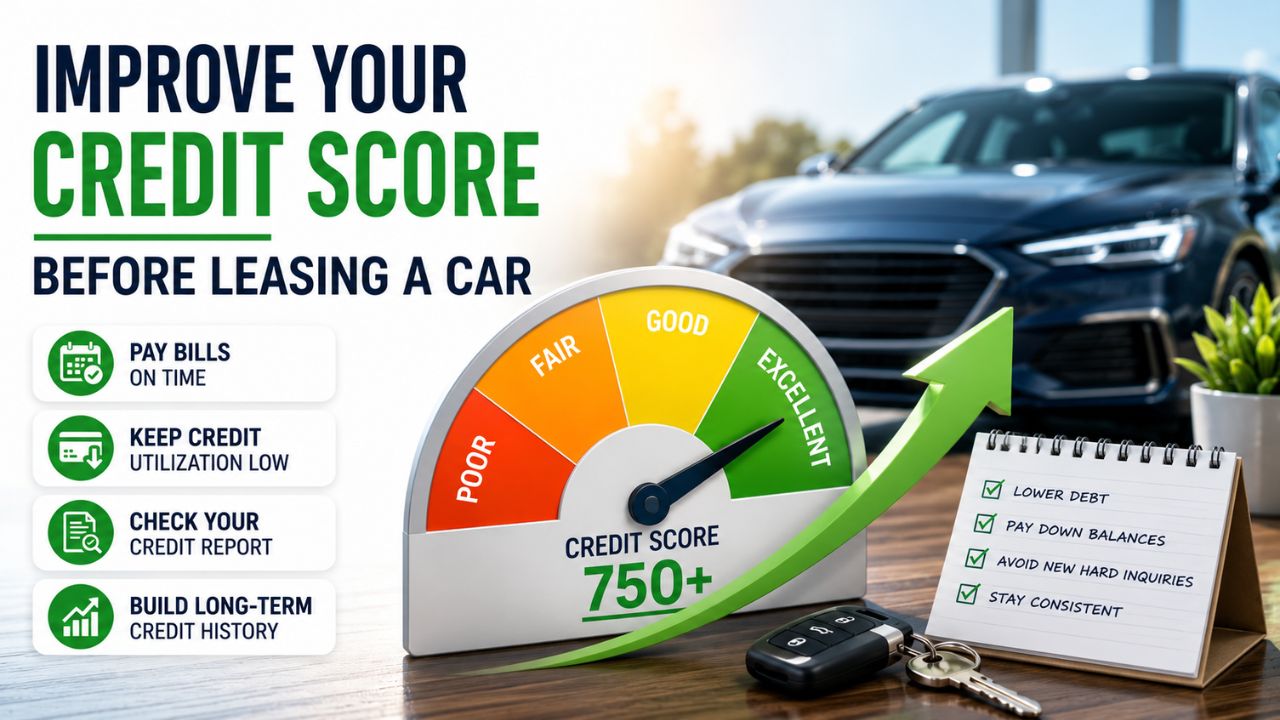
If your score isn’t where you want it to be, the good news is that credit scores respond to the right actions relatively quickly. Here’s what actually moves the needle:
Pay Down Revolving Balances
Credit utilization — how much of your available credit card limit you’re using — makes up 30% of your FICO score. Getting your utilization below 30% (and ideally below 10%) can add 20–50 points in a single billing cycle. If you have a $5,000 credit limit and carry a $2,500 balance, paying it to $500 has an immediate effect.
Dispute Errors on Your Credit Report
Around 1 in 5 credit reports contain errors significant enough to affect lending decisions, according to FTC research. Pull your free reports from AnnualCreditReport.com (US), Equifax/Experian/TransUnion (Canada/UK/Australia) and look for:
- Accounts that aren’t yours
- Late payments that were actually paid on time
- Accounts showing as open that you’ve closed
- Incorrect balances or credit limits
Disputing errors directly with the bureaus can resolve them within 30–45 days.
Don’t Close Old Accounts
The length of your credit history accounts for 15% of your FICO score. Closing old credit cards — even ones you don’t use — shortens your average account age and can temporarily drop your score.
Limit Hard Inquiries
Every time a lender pulls your credit for a loan or lease application, it creates a hard inquiry that typically costs 3–5 points. Multiple inquiries in a short period for the same type of credit (like rate shopping for a car) are usually treated as a single inquiry by FICO if done within a 14–45 day window, so do your lease shopping within that window.
Become an Authorized User
If a family member or trusted friend has a credit card with a long, clean history, being added as an authorized user can boost your score by inheriting some of that positive history — without needing to use the card at all.
Realistic Timelines
| Action | Potential Score Impact | Typical Timeline |
| Pay down credit card balances | +20 to +50 points | 1–2 billing cycles |
| Dispute and remove errors | +10 to +100+ points | 30–45 days |
| No new missed payments | +5 to +20 points | 6–12 months |
| Adding positive tradeline | +10 to +30 points | 1–3 months |
If you’re 6–12 months away from needing a car and your score is in the 620–680 range, a focused effort on utilization and errors could realistically get you into the prime tier before you apply.
Tips for Leasing a Car With Less-Than-Perfect Credit
Sometimes you can’t wait. Maybe your current car died and you need transportation now. Here are strategies to improve your chances even with a lower score:
Shop captive lenders last. Manufacturer finance arms (Toyota Financial, etc.) often have the tightest credit requirements. Banks and credit unions sometimes offer more flexibility, especially if you’ve been a long-term customer.
Offer a larger security deposit. Many lenders will approve a borderline applicant if you put up 2–3 months of payments as a security deposit. You get it back at lease end if you haven’t damaged the vehicle.
Add a co-signer. A co-signer with strong credit can unlock approval and better rates. Be aware that the co-signer is equally responsible for the debt if you stop paying — a decision that should never be taken lightly.
Choose a less expensive vehicle. The lower the monthly payment required, the better your DTI looks. Opting for a $22,000 economy car instead of a $40,000 crossover can be the difference between approval and decline.
Consider a shorter lease term. Some lenders prefer 24-month leases over 36 or 48 months for higher-risk applicants because it reduces their exposure window.
Check manufacturer incentives. Periodically, automakers run “loyalty” or “conquest” programs that offer subsidized rates to specific groups (existing customers, military, recent graduates). These can make approval accessible with lower scores during promotional periods.
Frequently Asked Questions
Can I lease a car with a 600 credit score?
It’s difficult but not impossible. Most mainstream dealerships and manufacturer finance arms will decline applications below 620, but some brands (notably Hyundai and Kia) have been more flexible. You may also have better luck with credit unions or by providing a larger security deposit and a co-signer. Expect significantly higher payments if approved.
Does applying for a car lease hurt my credit score?
Yes, briefly. A lease application triggers a hard inquiry, which typically drops your score by 3–5 points. The effect usually fades within 6–12 months. If you’re shopping multiple dealerships, do all your applications within 14–45 days — FICO treats multiple auto-related inquiries in that window as a single inquiry.
What’s the minimum credit score to lease a car with no money down?
Most lenders require a 700+ score to waive the security deposit and keep drive-off costs to just the first month’s payment and fees. Below 680, you’re likely to need at least one month’s deposit upfront, and below 640, some lenders require two to three months.
Is it better to lease or buy a car with bad credit?
If your score is below 620, buying a used car with a loan from a credit union or community bank may be more accessible than leasing. Used car loans tend to have more flexible credit requirements, and you’re building equity rather than returning the vehicle at the end. Buying also lets you eventually own the car outright, which eliminates the monthly payment entirely a meaningful financial milestone.
How does credit score affect monthly lease payments?
Your credit score primarily affects the money factor (the lease equivalent of an interest rate). A higher money factor means you pay more in financing charges each month. The difference between a super prime money factor and a near-prime money factor can add $100–$200 per month on a mid-range vehicle, totaling thousands of dollars over a 36-month lease.
Conclusion: Know Your Numbers Before You Walk In
Walking into a dealership without knowing your credit score is like negotiating a salary without knowing your market value. The dealer knows exactly what tier you fall into the moment they pull your report and if you don’t know it too, you’re at a disadvantage.
Here’s the short version of everything we’ve covered:
- 700+ score: You’re in a strong position. Shop freely, compare money factors, and don’t be afraid to negotiate.
- 660–699: Good odds of approval with competitive (not best) rates. Consider checking credit unions alongside manufacturer finance.
- 620–659: Possible but challenging. Focus on vehicles from more flexible brands, and consider offering a security deposit.
- Below 620: Focus on improving your score first if at all possible, or explore used car loans as an alternative.
Whatever your current score, the path forward is the same: pull your credit report, address any errors, reduce utilization if possible, and give yourself 6–12 months to improve if your timeline allows.
The best lease deal is the one where you walk in prepared knowing your score, knowing the current money factors on your preferred vehicle, and knowing exactly what you can afford. That preparation is worth far more than any promotional offer a dealer can throw at you.
Disclaimer: The information in this article is intended for general educational purposes. Credit requirements vary by lender, region, and vehicle. Always consult directly with lenders for the most accurate terms based on your individual financial situation.