 SENSE INSIDER Personal Finance, Smart Investing & Budgeting Tips

Most people were never taught that money can work just as hard as they do. You clock in, you get paid, and you do it all over again. But what if some of your money kept earning while you slept, took a vacation, or spent time with family? That is the basic idea behind income producing assets, and it is one of the most important concepts in personal finance.
Whether you are starting with $100 or $10,000, this guide breaks down 15 of the best income generating assets available in 2026, what to expect from each, how much you need to get started, and which ones make the most sense depending on where you are in your financial journey.
By the end, you will have a clear picture of what assets are worth your time and money, and how to start building a portfolio that actually pays you back.
What Are Income Producing Assets?
Before diving into the list, it helps to understand exactly what we mean. Income producing assets are things you own that generate regular cash flow, either through interest, dividends, rent, royalties, or profit distributions.
The best assets to invest in do two things at once: they grow in value over time and they send money back to you along the way. That combination of appreciation and cash flow is what separates true wealth building from just saving money in a bank account.
Here is a simple way to think about it: if you stopped working tomorrow, income generating assets would keep paying you. The goal for many people is to build enough of these assets that the income they produce covers their monthly expenses.
Why Income Generating Assets Matter More Than Ever in 2026
Wages are growing slowly in the US, UK, Canada, and Australia. Meanwhile, the cost of living continues to climb. Relying on a single income source has become a financial vulnerability, not a strategy.
Cash producing assets create a buffer. They give you options. You can reinvest the income to grow your wealth faster, use it to cover expenses, or hold it as a cushion against job loss or unexpected bills.
Beyond stability, investing in income producing assets is how most wealthy people actually build their net worth. It is not about working harder. It is about putting money into things that generate returns on their own.
The 15 Best Income Producing Assets to Consider in 2026
1. Dividend Stocks
Minimum to start: Around $1 to $50 per share depending on the company
Dividend stocks are shares of companies that pay out a portion of their profits to shareholders on a regular basis, usually quarterly. If you own 100 shares of a company paying $2 per share annually, you collect $200 every year without doing a thing.
Some of the most reliable dividend payers are in sectors like utilities, consumer staples, and healthcare. In the US, companies like Johnson and Johnson, Coca-Cola, and Procter and Gamble have paid dividends for decades. In Australia, big banks and resource companies often carry strong yields. UK investors often look to FTSE 100 stalwarts, while Canadian investors have long favored the big five banks for their consistent payouts.
Dividend investing is one of the most accessible examples of income producing assets because you can start small and reinvest your payouts to compound over time through a Dividend Reinvestment Plan (DRIP).
Realistic return: 2% to 6% dividend yield annually, plus potential capital appreciation.
2. Real Estate Rental Properties
Minimum to start: Varies widely, but typically $20,000 to $50,000+ for a down payment
Owning rental property is one of the oldest and most proven forms of income generating assets. You buy a property, rent it out, and collect monthly income after covering your mortgage and expenses.
The beauty of real estate is leverage. You might put down 20% of a property’s value and collect rent on 100% of it. Over time, the property (ideally) appreciates in value while your tenants are essentially paying off your mortgage.
In cities like Austin, Manchester, Toronto, and Brisbane, well-chosen rental properties have delivered solid returns over the past decade. The challenges are the upfront costs, property management responsibilities, and the fact that tenants and repairs can be unpredictable.
For many people, rental property becomes a serious wealth building engine once they have two or three properties generating consistent monthly cash flow.
Realistic return: 6% to 12% cash-on-cash return depending on the market and property type.
3. Real Estate Investment Trusts (REITs)
Minimum to start: As low as $10 to $50 through an index fund or ETF
If owning physical property sounds like too much work or you do not have enough saved for a down payment, REITs are the next best thing. A REIT is a company that owns income-producing real estate, like apartment complexes, office buildings, or warehouses. By law in the US, they must pay out at least 90% of taxable income as dividends.
You can buy shares of a REIT on the stock market the same way you would buy any stock. This makes them one of the most liquid cash producing assets available. Similar structures exist in Canada (through REITs), Australia (through listed property trusts), and the UK (through Real Estate Investment Trusts under UK REIT rules).
Realistic return: 3% to 8% dividend yield, plus price appreciation.
4. High-Yield Savings Accounts and Money Market Accounts
Minimum to start: $1 in most cases
Not every income producing asset needs to be complicated. A high-yield savings account is one of the simplest and safest options available, especially for people just getting started or building up an emergency fund.
As of 2026, many online banks in the US, UK, Canada, and Australia are offering competitive rates well above the traditional 0.01% offered by big brick-and-mortar banks. The tradeoff is that the returns are lower than most other assets on this list, but the money is accessible and your principal is protected.
Money market accounts work similarly but may offer slightly higher rates and sometimes come with check-writing privileges.
Realistic return: 4% to 5% annually (rates fluctuate with central bank decisions).
5. Bonds and Bond Funds
Minimum to start: $100 for US Treasury bonds, as little as $10 for bond ETFs
When you buy a bond, you are lending money to a government or corporation in exchange for regular interest payments and the return of your principal at maturity. Bonds are one of the most traditional examples of income producing assets and are especially popular among investors who want predictable, lower-risk returns.
US Treasury bonds, UK gilts, Canadian government bonds, and Australian government securities are all backed by their respective governments, making them among the safest income generating assets available.
Corporate bonds carry more risk but tend to pay higher interest rates. Bond ETFs make it easy to hold a diversified basket of bonds without needing to buy individual issues.
Realistic return: 3% to 7% annually depending on bond type, credit quality, and duration.
6. Peer-to-Peer Lending
Minimum to start: $25 to $100 on most platforms
Peer-to-peer (P2P) lending platforms connect borrowers directly with individual lenders, cutting out the bank. You put in money, the platform distributes it across multiple loans, and you earn interest as borrowers repay.
Platforms like LendingClub in the US and Funding Circle (UK and beyond) have made this type of investing accessible. The risk is that some borrowers default, so spreading your money across many loans is essential.
P2P lending is one of the more interesting cash producing assets for those comfortable with slightly higher risk in exchange for higher returns.
Realistic return: 5% to 10% annually before accounting for defaults.
7. Certificates of Deposit (CDs)
Minimum to start: $500 to $1,000 typically
A certificate of deposit is essentially an agreement with a bank: you lock in your money for a set period (3 months to 5 years) and receive a guaranteed interest rate. The longer you lock it in, the higher the rate.
CDs are FDIC-insured in the US (up to $250,000), which makes them as safe as savings accounts but with better rates. In Canada, similar instruments are called Guaranteed Investment Certificates (GICs). Australians have term deposits. UK residents have fixed-rate bonds from banks.
The main downside is that your money is not accessible without a penalty during the term, so they work best as part of a broader income portfolio.
Realistic return: 4% to 5.5% depending on term length and current rates.
8. Index Funds and ETFs
Minimum to start: As low as $1 through fractional shares
Index funds and exchange-traded funds (ETFs) are one of the most beginner-friendly examples of income producing assets because they are simple, low-cost, and automatically diversified. A total market index fund, for example, gives you ownership of hundreds or thousands of companies at once.
Many index funds pay dividends, which creates a stream of income. Over long periods, broad index funds have historically delivered strong returns, making them a core component of most long-term wealth building strategies.
If you want a straightforward place to start investing without needing to pick individual stocks, index funds are hard to beat. You can learn more about building confidence as a new investor in our guide on 7 Proven Strategies to Invest with Confidence.
Realistic return: 7% to 10% average annual return over long periods, including dividends.
9. Rental Income from Short-Term Rentals
Minimum to start: Varies; a spare room can generate income with minimal upfront cost
Short-term rentals through platforms like Airbnb and Vrbo have made it possible for homeowners to turn a spare room, a basement apartment, or a second property into a genuine income stream. In popular cities and tourist destinations across the US, UK, Canada, and Australia, short-term rental income can significantly outperform traditional long-term leases.
The tradeoff is more active management. You are handling bookings, cleaning, guest communication, and occasional repairs. But for many people, it is worth the effort for the higher per-night rates.
Some hosts earn $1,000 to $5,000+ per month from a single property, depending on the location and how well it is marketed.
Realistic return: Highly variable, but often 10% to 20%+ gross yield compared to 6% to 8% for long-term rentals.
10. Digital Products and Online Courses
Minimum to start: Near zero if you create the product yourself
Creating a digital product, whether it is an e-book, a template pack, a photography preset collection, or a full online course, is one of the few examples of income producing assets that costs almost nothing to build and can generate income indefinitely.
Once created, a digital product can sell thousands of times with no additional effort on your part. Platforms like Gumroad, Teachable, and Udemy handle the delivery and payments. The hard part is building the product and marketing it to the right audience.
This type of asset rewards people who have expertise in a particular field, whether that is graphic design, cooking, fitness, coding, or finance. The income is not guaranteed, but the potential is significant for those willing to put in the upfront work.
Realistic return: Highly variable, from a few hundred dollars a month to six figures annually.
11. Royalties (Music, Books, Photography, and More)
Minimum to start: Low to moderate depending on the medium
Royalties are payments you receive whenever someone uses your creative work. Writers earn royalties on book sales. Musicians earn royalties when their songs are streamed or licensed. Photographers earn royalties when their images are downloaded from stock sites like Shutterstock or Adobe Stock.
For creative people, royalties represent one of the most appealing income generating assets because the work is done once and the income flows for years. A well-written book or a collection of stock photos can quietly generate monthly income for a long time.
The challenge is that most royalty income is modest unless your work gains significant traction. But even small, consistent payments add up over time.
Realistic return: Modest but potentially long-lasting; highly dependent on the quality and reach of your work.
12. Business Ownership and Equity
Minimum to start: Varies dramatically
Owning equity in a business, whether it is your own company or a share in someone else’s, is one of the most powerful income producing assets available. When a business generates profit, owners receive distributions based on their ownership percentage.
For those looking to build wealth beyond the stock market, buying into a small business, starting a side hustle that scales, or purchasing a franchise can create significant cash flow over time. If you are interested in building income through your own efforts first, our article on side hustles for high schoolers shows how even young people are starting to build income-generating activities from scratch.
This is not a passive asset in the traditional sense, especially in the early stages, but business equity can eventually become a source of truly passive income once systems and teams are in place.
Realistic return: Highly variable; successful small businesses can generate 20% to 50%+ returns on invested capital.
13. Treasury Inflation-Protected Securities (TIPS)
Minimum to start: $100 through TreasuryDirect.gov
For US-based investors concerned about inflation eating into their returns, TIPS are a specialized type of government bond designed specifically to protect purchasing power. The principal value of a TIPS adjusts with inflation, and you earn interest on the adjusted amount.
This makes them particularly attractive during periods of elevated inflation, like the kind many countries have experienced in recent years. They are not glamorous, but they are reliable and government-backed.
Realistic return: Inflation rate plus a small real yield, typically 1% to 2% above inflation.
14. Annuities
Minimum to start: Typically $10,000 to $50,000 or more
An annuity is a contract with an insurance company. You hand over a lump sum of money and, in return, the company promises to pay you a fixed monthly income for a set period or for the rest of your life. This makes annuities one of the most predictable income producing assets for retirees or those approaching retirement.
There are several types, including fixed annuities, variable annuities, and indexed annuities. Fixed annuities are the simplest and most predictable. Variable and indexed annuities can offer higher returns but come with more complexity and risk.
Annuities have a reputation for high fees and confusing terms, so careful comparison and ideally consultation with a financial advisor is strongly recommended before purchasing.
Realistic return: Fixed annuities typically offer 4% to 6% effective payout rates depending on your age and the terms.
15. Farmland and Agricultural Investments
Minimum to start: As low as $1,000 through farmland investment platforms
Farmland has been one of the most consistent income producing assets over the past several decades. Unlike most investments, it combines a tangible asset (the land) with an ongoing income stream (crop revenue or lease payments from farmers).
Platforms like AcreTrader and FarmTogether in the US have made it possible for regular investors to own fractional shares of farmland without needing to buy an entire farm. This opens up an asset class that was previously only accessible to the wealthy or those with family connections to agriculture.
Farmland has historically kept pace with or exceeded inflation, making it a strong long-term holding.
Realistic return: 7% to 12% average annual return historically, including both rental income and land appreciation.
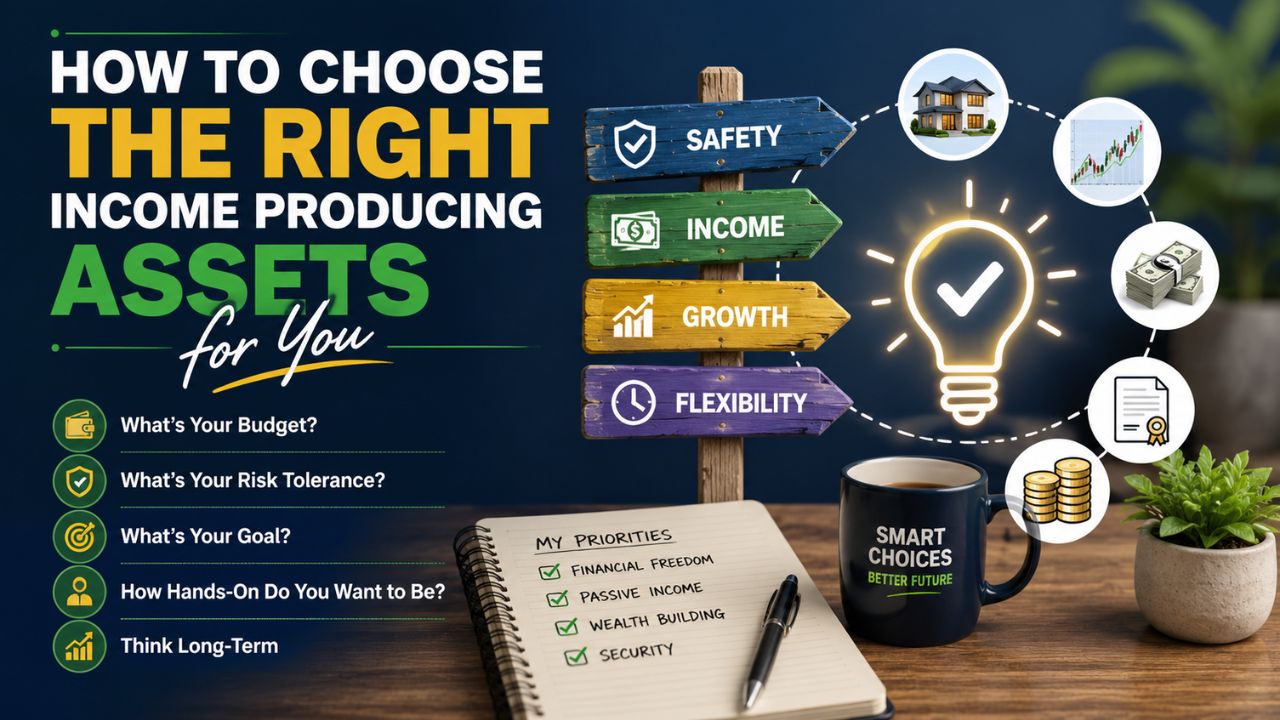
How to Choose the Right Income Producing Assets for You
The best income generating assets for one person may not be the best for another. A few questions worth asking yourself before investing:
How much can you invest right now? If you are starting with $100 or less, dividend stocks, index funds, and high-yield savings accounts are the most accessible options. Farmland, rental properties, and annuities require significantly more capital.
How much time do you want to spend managing your investments? Digital products, rental properties, and P2P lending require more active involvement. Dividend stocks, index funds, and CDs are largely hands-off once set up.
How much risk can you handle emotionally and financially? Bonds, CDs, and savings accounts carry the least risk. Business equity, digital products, and P2P lending carry more. Most financial advisors recommend spreading your money across multiple asset types to manage overall risk.
What is your time horizon? If you need income now, higher-yield options like rental property or short-term rentals may be more appropriate. If you are building for the next 20 to 30 years, index funds and dividend growth stocks tend to shine over long periods.
Building a Portfolio of Good Assets to Invest In
One of the most important principles in wealth building is diversification. Rather than putting all your money into a single asset class, spreading across several good assets to invest in reduces your overall risk and creates multiple income streams.
A simple example for someone starting with $5,000 might look like this: $2,000 into a dividend-focused index ETF, $1,500 into a high-yield savings account or CD, $1,000 into REITs, and $500 held in reserve for future opportunities. As that grows and you add more each month, you gradually layer in additional income streams.
Many people who achieve financial independence do not do it by finding one perfect asset. They do it by consistently investing in multiple income producing assets over years and decades, letting compound growth do the heavy lifting. For a broader look at building wealth from the ground up, our guide on how to make $50 a day covers practical ways to generate cash you can then redirect into assets.
Frequently Asked Questions About Income Producing Assets
What is the best income producing asset for beginners?
For most beginners, dividend-paying index funds or ETFs are the ideal starting point. They require very little money to start (sometimes under $10), they are automatically diversified, and many pay quarterly dividends that can be reinvested to grow your wealth over time. High-yield savings accounts are also a strong starting point for building up capital before investing.
Can you really live off income producing assets?
Yes, many people do. The concept is often called financial independence or passive income living. The key is building enough assets that the income they generate each month covers your living expenses. Depending on your lifestyle, that might require $500,000 to $2 million or more in income generating assets, but you do not need to reach that goal all at once. Even $10,000 invested at a 5% return generates $500 per year, which you can then reinvest to grow faster.
How much money do I need to start investing in income producing assets?
You can start with as little as $1 through some brokerage platforms that offer fractional shares and fee-free investing. High-yield savings accounts have no minimums at many online banks. The real question is not how much you need to start, but whether you are starting at all. Beginning with even a small amount builds the habit and lets compound growth begin working in your favor.
Are income producing assets taxable?
Yes, most income from assets is taxable, though the rate and rules vary depending on your country and the type of income. Dividends and capital gains are taxed differently in the US, UK, Canada, and Australia. Rental income is generally taxed as ordinary income. Some accounts like Roth IRAs (US), ISAs (UK), TFSAs (Canada), and superannuation contributions (Australia) allow you to shelter investment income from taxes. It is worth understanding the tax treatment of any asset before investing and consulting a tax professional if your situation is complex.
What are the safest income producing assets?
Government bonds, FDIC-insured CDs, and high-yield savings accounts are generally considered the safest options because your principal is protected and returns are predictable. REITs, dividend stocks, and index funds carry more market risk but have historically delivered strong returns over long periods. Safety always comes with a tradeoff: the safest assets typically offer the lowest returns.
Start Building Your Income Producing Asset Portfolio Today
Building real wealth is not about getting lucky or earning a six-figure salary. It is about consistently directing money into income producing assets and letting time do the work. Whether you start with $100 in a high-yield savings account or $10,000 split across dividend stocks and REITs, the most important step is the first one.
Start small if you need to. Add more when you can. Diversify across multiple income generating assets as your knowledge and capital grow. And always keep learning, because the more you understand about how money can work for you, the better your decisions will be.
Ready to take your first step? Explore the investing and wealth building resources on SenseInsider for practical guidance on building the financial future you want, one asset at a time.