 SENSE INSIDER Personal Finance, Smart Investing, Passive Income and Side Hustle & Budgeting Tips

You’ve probably walked past a credit union without giving it much thought. Maybe you assumed it was just a smaller, less convenient version of a bank. Or maybe you signed up with a big bank years ago and never questioned whether there was something better out there.
Here’s the thing: millions of people across the USA, UK, Canada, and Australia are quietly saving hundreds, sometimes thousands of dollars every year, simply by banking somewhere different.
Credit unions offer a range of financial products that go head-to-head with traditional banks, but with one key difference: they’re built to serve their members, not shareholders. That shift in structure changes almost everything, from the interest rate on your savings account to how you’re treated when you call customer service.
In this guide, you’ll get a clear credit union definition, a full breakdown of how the credit union vs bank comparison actually plays out, and 15 real, tangible credit union benefits that could save you serious money over time. By the end, you’ll know exactly whether switching makes sense for you.
What Is a Credit Union? A Quick Credit Union Definition
A credit union is a member-owned, not-for-profit financial cooperative. Instead of generating profit for outside investors, any surplus earnings are returned to members through lower loan rates, higher savings rates, and reduced fees.
To join a credit union, you typically need to meet a membership requirement. This might be living in a certain geographic area, working for a specific employer, or belonging to a professional association. Once you’re in, you’re not just a customer, you’re a part-owner with voting rights.
Credit unions offer many of the same products as banks: checking and savings accounts, mortgages, auto loans, personal loans, credit cards, and even investment services. The credit union difference from a bank comes down to structure and motive.
Credit Union vs Bank: The Key Structural Difference
Banks are for-profit institutions that answer to shareholders. Their goal is to maximize profit, which often means charging higher fees and offering lower interest on deposits.
Credit unions are not-for-profit cooperatives that answer to members. Their goal is to provide the best possible financial products to the people they serve. That’s the core of why credit union benefits can be so significant in practice.
15 Credit Union Benefits That Can Save You Real Money
1. Lower Interest Rates on Loans
One of the most immediate credit union benefits is the difference in loan rates. Because credit unions are not chasing profit margins, they routinely offer lower interest rates on auto loans, personal loans, and mortgages compared to traditional banks.
On a $25,000 auto loan over 60 months, even a 1.5% rate difference can save you over $1,000 in interest. For a mortgage, the savings over 25 or 30 years can run into the tens of thousands. If you’re financing anything significant, this is the single biggest reason to shop with a credit union first.
2. Higher Interest Rates on Savings Accounts
On the flip side, credit unions tend to offer better returns on savings accounts and certificates of deposit (called term deposits in the UK and Australia). While big banks often pay minimal interest on standard savings accounts, credit unions regularly outperform them.
Over years of consistent saving, that difference compounds into real money. It’s one of the quieter credit union benefits, but also one of the most consistent.
3. Fewer and Lower Fees
Monthly maintenance fees, ATM fees, overdraft fees, minimum balance fees: traditional banks collect billions from these charges every year. Credit unions, because they’re not profit-driven, typically charge far less or nothing at all.
Many credit union members pay zero monthly fees on their checking accounts. If you’re currently paying $12 to $15 per month in bank fees, switching could save you $150 to $180 a year without changing anything else about how you bank.
4. Easier Loan Approval for Members
Credit unions are known for looking at the full picture when evaluating loan applications. Rather than running your numbers through an algorithm and sending an automated rejection, they tend to consider your overall relationship with the institution, your employment history, and your circumstances.
This is especially valuable for first-time borrowers, people rebuilding credit, or anyone whose financial situation doesn’t fit neatly into a standard credit scoring model. The credit union vs bank difference here is often the difference between approval and denial.
5. Credit-Builder Loan Programs
Many credit unions offer dedicated credit-builder loans, products specifically designed to help members establish or repair their credit history. You make payments over a set period, those payments are reported to credit bureaus, and at the end of the term, you receive the loan amount.
It’s a structured way to build your score without taking on risky debt. Banks rarely offer this kind of product, and when they do, it’s usually with stricter terms.
6. Personalized Customer Service
You know the experience of calling a bank’s customer service line and ending up on hold for 45 minutes, then speaking to someone reading from a script. Credit unions are different.
Because they serve smaller, defined communities, credit union staff often know their members personally. Decisions are made locally. You can actually talk to someone who has the authority to help you. This isn’t just a nice-to-have; it matters enormously when you’re dealing with a disputed charge, a financial hardship, or a complex loan situation.
7. Democratic Member Governance
As a credit union member, you have a vote. Every eligible member can participate in annual meetings and vote for the board of directors. This means the institution is genuinely accountable to the people it serves.
When a bank raises fees or changes a product, customers have no recourse. When a credit union considers a significant change, members can have a direct say. That structural accountability is one of the most underappreciated credit union benefits.
8. Lower Credit Card Rates
Credit union credit cards often carry significantly lower annual percentage rates (APRs) than cards issued by major banks. If you carry a balance from month to month, even a few percentage points of difference can save you hundreds of dollars per year in interest charges.
Credit union cards also tend to come with fewer penalty fees and more straightforward terms. If you’re currently paying 20% or more on a bank-issued card, it may be worth checking what your local credit union offers.
9. ATM Access and Shared Branching Networks
One common concern people raise when comparing credit union vs bank options is convenience. What about ATMs? What about branches when you travel?
Most credit unions in the USA and Canada belong to shared branching networks, which allow members to conduct transactions at thousands of partner locations nationwide. Many also participate in fee-free ATM networks with tens of thousands of machines. Access is rarely as limited as people assume.
10. Financial Education and Counseling
Credit unions have a mission to improve the financial wellbeing of their members, and many back that up with free financial education resources, budgeting workshops, and one-on-one counseling services.
Whether you’re a young adult opening your first account or someone working through debt, having access to genuine, unbiased financial guidance is a benefit that goes beyond what most banks offer.
11. Mortgage Advantages
For homebuyers, the mortgage benefits of banking with a credit union can be substantial. Lower rates, reduced closing costs, more flexible underwriting, and in many cases, the ability to work directly with a local loan officer who understands your regional market.
In markets where housing prices are high, even a modest reduction in your mortgage rate translates to significant long-term savings. If you’re financing a vehicle alongside a home purchase, it’s also worth reading about lease buyout loans to understand all your financing options before committing to any lender.
12. Student Loan Options
Some credit unions offer student loans or student loan refinancing at competitive rates, particularly through university or college-affiliated credit unions. If you have existing student debt at a high interest rate, refinancing through a credit union can reduce your monthly payment and the total amount you pay over the life of the loan.
13. Insurance and Investment Services
Many larger credit unions now offer a full suite of financial services beyond banking, including life insurance, auto insurance, retirement accounts, and investment products. These are often available at competitive rates and with the same member-first approach that defines the credit union model.
Consolidating your finances under one institution that genuinely has your interests at heart can simplify your financial life considerably.
14. Community Investment
Credit unions are deeply embedded in the communities they serve. They tend to reinvest locally, support community programs, and make lending decisions that benefit the people and businesses in their area, not distant shareholders.
If you care about where your money goes and what it supports, there is a meaningful ethical difference between keeping it in a credit union versus a large commercial bank.
15. NCUA and FSCS Protection
A concern some people have about credit unions is whether their deposits are safe. In the USA, deposits at federally insured credit unions are protected by the National Credit Union Administration (NCUA) up to $250,000, exactly the same level of protection as FDIC-insured bank accounts.
In the UK, eligible deposits are protected under the Financial Services Compensation Scheme (FSCS). In Canada and Australia, similar regulatory frameworks apply. Your money is not at greater risk at a credit union than at a bank.
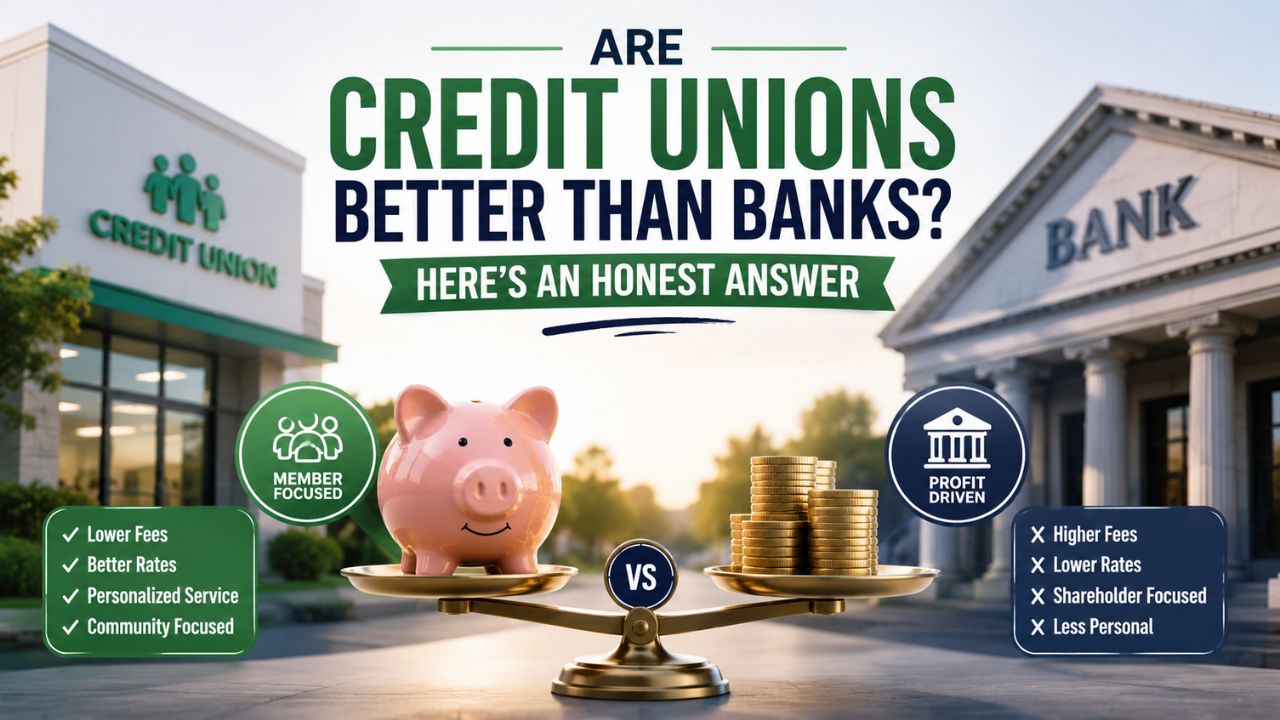
Are Credit Unions Better Than Banks? Here’s an Honest Answer
The direct answer to the question ‘are credit unions better than banks?’ is: for most everyday banking needs, credit unions offer equal or better value than traditional banks.
That said, there are situations where a large bank makes more sense. If you travel internationally very frequently and need seamless global services, some larger banks may offer more integrated solutions. If you need highly specialized corporate banking products, credit unions may not offer them.
But for the vast majority of individuals and families managing mortgages, car loans, savings, and everyday spending, the credit union difference is consistently favorable. Lower costs, better rates, and genuine member service are hard to argue against.
One area where the difference is particularly clear is auto financing. If you’re thinking about how to build your credit score through responsible borrowing, check out this guide on whether financing a car builds credit and how credit unions compare for that type of loan.
Why Credit Union Is Better Than a Bank for Savers Specifically
If growing your savings is a priority, the comparison becomes even more lopsided. Here’s a quick breakdown of where credit unions typically outperform banks for savers:
- Higher APY on savings accounts and money market accounts
- Better rates on certificates of deposit (CDs) or term deposits
- No or low minimum balance requirements
- No monthly maintenance fees eating into your balance
- Profit sharing or dividend payments returned to members in some institutions
For people who want to put their savings to work even harder, credit union accounts can serve as a foundation alongside other wealth-building strategies. For broader ideas on growing your money, our guide on income-producing assets covers a range of options from conservative to growth-oriented.
How to Join a Credit Union in the USA, UK, Canada, and Australia
The process of joining a credit union is simpler than most people expect. Here’s how it typically works in each market:
USA
Use the NCUA’s online locator at mycreditunion.gov to find credit unions you’re eligible to join. Common eligibility criteria include your employer, union membership, geographic area, or family connection to an existing member. Some credit unions have open membership for anyone in a particular state or region.
UK
Search the Association of British Credit Unions Limited (ABCUL) directory to find a local credit union. Eligibility often relates to where you live, work, or worship. The UK credit union sector has grown significantly in recent years, with options available in most regions.
Canada
Credit unions are provincially regulated in Canada, and most provinces have their own credit union central organization. In Quebec, they’re known as caisses populaires. Search your provincial credit union association for options near you.
Australia
In Australia, credit unions have largely merged under the mutual bank or customer-owned bank model, regulated by APRA. The Customer Owned Banking Association (COBA) maintains a directory of institutions. Your deposits are protected under the Financial Claims Scheme (FCS) up to AUD 250,000.
Frequently Asked Questions About Credit Union Benefits
What is the main difference between a credit union and a bank?
The main credit union difference from a bank is ownership structure. Banks are owned by shareholders and operate for profit. Credit unions are owned by their members and operate on a not-for-profit basis. This means credit unions return their earnings to members through better rates, lower fees, and improved services rather than distributing them as shareholder dividends.
Are credit unions safer than banks?
Yes, credit unions are just as safe as banks. In the USA, federally chartered credit unions are insured by the NCUA up to $250,000 per member, per account category, which is identical to the FDIC protection offered at insured banks. In the UK, FSCS protection applies. In Canada and Australia, comparable regulatory protections are in place. There is no meaningful difference in deposit safety between a regulated credit union and a regulated bank.
Can anyone join a credit union?
Most credit unions have membership eligibility requirements, but they are often broader than people assume. Many credit unions allow anyone who lives or works in a particular city or region to join. Others are tied to specific employers, professions, or communities. With over 5,000 credit unions operating in the USA alone, the likelihood of finding one you’re eligible for is high. Some credit unions also allow you to join simply by making a small donation to a qualifying charitable partner.
Do credit unions offer the same products as banks?
For most everyday financial needs, yes. Credit unions offer checking and savings accounts, mortgages, auto loans, personal loans, credit cards, retirement accounts, and in many cases, insurance and investment products. The main areas where large commercial banks have an edge are in highly specialized corporate banking products and international banking services. For individual and family banking needs, credit unions typically cover everything you’ll need.
Will switching to a credit union hurt my credit score?
Switching financial institutions does not directly hurt your credit score. Closing old bank accounts has no impact on credit scores at all, since bank accounts are not reported to credit bureaus. Opening new credit products (like a credit card or loan) at a credit union may result in a brief, minor dip in your score due to the hard inquiry, but this typically recovers within a few months and the positive effect of responsibly managed accounts outweighs it over time.
Final Thoughts: Is It Time to Make the Switch?
The credit union benefits outlined here are not hypothetical. They’re the result of a fundamentally different approach to financial services, one that puts the member first in every decision.
Lower loan rates, higher savings yields, fewer fees, better customer service, community investment, and the same deposit protections as any bank: it’s a compelling list. For most people comparing credit union vs bank options, the credit union wins on the majority of criteria that actually affect day-to-day finances.
If you’ve never seriously considered making the switch, now is a good time to start. Use the tools mentioned in this guide to find a credit union you’re eligible to join, compare their current rates and account terms against what you’re paying now, and calculate what the difference would actually be for your situation.
You might be surprised how much you could save simply by banking somewhere that was designed to work for you.
Ready to take control of your financial future? Explore more money-saving strategies and smart borrowing guides at Sense Insider.