 SENSE INSIDER Personal Finance, Smart Investing, Passive Income and Side Hustle & Budgeting Tips

College tuition is expensive, student loan debt is brutal, and a four-year degree no longer guarantees a six-figure salary. So it makes sense that more people are asking a very practical question: which blue collar jobs actually pay well?
The answer might surprise you. Several trades and skilled labor roles now offer salaries that rival or outpace many white-collar professions, with the added benefit of job security, union protections, and real demand that is not going anywhere. In the US, UK, Canada, and Australia, skilled tradespeople are in short supply, which means employers are paying more to attract and keep them.
This guide breaks down 15 of the highest paying blue collar jobs available in 2026, including what each role pays, what it takes to get in, and who it is best suited for. Whether you are starting fresh, switching careers, or just tired of working a job that does not pay what your effort is worth, this list gives you concrete options.
What Counts as a Blue Collar Job?
Before diving into the list, it helps to define the term. Blue collar jobs are roles that involve manual labor, skilled trades, or technical hands-on work. They are typically learned through apprenticeships, vocational training, or on-the-job experience rather than a four-year university degree.
Blue collar jobs examples include electricians, plumbers, welders, truck drivers, construction workers, HVAC technicians, and more. The term does not mean low-wage. In fact, many of the highest paying blue collar jobs without a degree outpay jobs that require years of college education.
Why Blue Collar Salaries Are Rising in 2026
The skilled trades gap is real. Across the US, UK, Canada, and Australia, millions of experienced tradespeople are retiring faster than new workers are replacing them. According to industry data, the US alone faces a shortage of over 500,000 skilled tradespeople in sectors like construction, electrical work, and plumbing.
Add rising infrastructure investment, increased housing construction, and a growing demand for energy transition work (solar, wind, and EV infrastructure), and you have a market that is tilting heavily in favor of workers with hands-on skills.
If you are exploring ways to increase your income beyond a trade career, take a look at this piece on how to earn extra income while working full time for practical strategies that work alongside any job.
The 15 Highest Paying Blue Collar Jobs in 2026
1. Elevator Installer and Repairer
Average Annual Salary: $97,000 – $130,000+
This is consistently one of the highest paying blue collar jobs in the US. Elevator installers and repairers install, maintain, and fix elevators, escalators, and moving walkways in commercial and residential buildings.
The work requires precision, an understanding of electrical and mechanical systems, and the ability to work in confined spaces. Entry is typically through a four-year apprenticeship run by the International Union of Elevator Constructors (IUEC).
Demand is strong in cities where construction and commercial real estate activity is high. In the UK and Australia, equivalent roles in lift engineering pay comparably well. Union wages, overtime pay, and benefits packages push total compensation even higher for experienced installers.
Best for: People who enjoy technical problem-solving and are comfortable with heights and tight spaces.
2. Power Line Technician (Lineman)
Average Annual Salary: $85,000 – $120,000+
Linemen install and maintain the electrical transmission lines that power homes and businesses. The work is physically demanding, often hazardous, and involves working at significant heights in all weather conditions. Because of this, the blue collar salary for experienced linemen is among the highest in any trade.
Apprenticeships typically last four to five years, and the work is unionized in most US states and Canadian provinces. Overtime pay during emergencies and storm restoration can push annual earnings well above base salary.
In Australia, power line workers with experience at major utilities can earn even more. The global push toward renewable energy grids also means this trade will remain in demand for decades.
Best for: People who want outdoor work, are not afraid of heights, and want strong union protections.
3. Industrial Pipefitter
Average Annual Salary: $75,000 – $110,000
Pipefitters install and maintain the pipe systems used in manufacturing plants, refineries, power stations, and other industrial facilities. Unlike plumbers who primarily work on water systems in residential buildings, industrial pipefitters work with high-pressure gas, steam, and chemical systems.
Entry is through a five-year apprenticeship. Specialized certifications, especially for oil refinery or nuclear power plant work, push salaries significantly higher. Contract work in remote industrial sites often comes with housing allowances and per diem pay that adds substantially to annual earnings.
This is one of the blue collar jobs that pay well even at entry level, with apprentice wages starting comfortably above minimum wage.
Best for: People who enjoy precision mechanical work and are open to working on industrial or energy sites.
4. Construction and Building Inspector
Average Annual Salary: $68,000 – $105,000
Building inspectors review construction projects to make sure they comply with local codes, safety standards, and zoning laws. It is a less physically intensive blue collar role that combines field work with regulatory knowledge.
In most US states, the path in involves several years of experience in a related trade like carpentry, plumbing, or electrical work, followed by a certification exam. Many inspectors come from construction backgrounds and transition into this role for better pay and less physical strain.
Demand is consistent in growing cities across the US, UK, Canada, and Australia, where new construction activity keeps the workload steady.
Best for: Experienced tradespeople looking to move into a supervisory or compliance-focused role.
5. Electrician (Master or Journeyman)
Average Annual Salary: $65,000 – $105,000
Electricians install, maintain, and repair electrical systems in residential, commercial, and industrial settings. It is one of the most widely recognized blue collar jobs examples and one of the most reliably well-paid.
The path typically involves a four-to-five-year apprenticeship, after which workers earn their journeyman license. Advancing to master electrician status unlocks higher-paying project and supervisory work. Specializing in industrial electrical systems or data center infrastructure can push salaries well above the average.
Union electricians in the US and Canada often earn more, with better benefits and retirement packages. In the UK, fully qualified electricians working in commercial and industrial sectors regularly earn above 50,000 GBP. In Australia, licensed electricians in Western Australia and Queensland benefit from a tight labor market and strong wages.
Best for: People who want a trade with consistent work, multiple specialization paths, and strong long-term earning potential.
6. HVAC Technician (Heating, Ventilation, and Air Conditioning)
Average Annual Salary: $58,000 – $95,000
HVAC techs install and service heating and cooling systems in homes, offices, and industrial buildings. With climate change pushing more extreme temperatures in both directions, demand for skilled HVAC workers is growing fast in every major market.
Training takes two to five years and typically involves a combination of vocational school and on-the-job apprenticeship. Specializing in commercial refrigeration or industrial HVAC systems opens up higher-paying work. In hotter markets like Texas, Arizona, and parts of Australia, HVAC techs with their own client base can earn significantly above average.
This is a trade that also lends itself well to self-employment once you have the skills and licenses in place.
Best for: People who enjoy troubleshooting mechanical systems and want a trade with strong year-round demand.
7. Plumber
Average Annual Salary: $60,000 – $95,000
Plumbing is one of the classic blue collar jobs that pay well, and it still earns that reputation. Plumbers install and repair water, drainage, and gas systems in residential, commercial, and industrial settings.
Like electricians, plumbers move through apprenticeship to journeyman and then master status. Plumbers who specialize in commercial or industrial projects tend to earn more than those focused on residential service calls. Emergency call-out rates are high, which means experienced plumbers who are willing to work evenings and weekends can earn considerably above base rates.
Self-employment is common in this trade. Many journeyman plumbers eventually start their own companies and earn well into six figures. In the UK, gas-safe registered plumbers are in particularly high demand, and in Australia, licensed plumbers in urban markets earn competitive wages with strong demand.
Best for: People who want a trade with clear career progression and a realistic route to self-employment.
8. Commercial Diver
Average Annual Salary: $65,000 – $100,000 (with offshore work paying much more)
Commercial divers carry out underwater construction, inspection, welding, and salvage work. It is a niche but well-compensated blue collar career, especially for divers working on offshore oil and gas infrastructure or marine construction projects.
Training involves a six-month to one-year commercial diving program followed by certifications specific to the type of diving work. Entry-level pay is modest, but offshore divers with saturation diving certification can earn over $150,000 per year. The work is physically demanding and carries inherent risk, which is reflected in the pay.
Best for: People who want something genuinely different, are comfortable in extreme environments, and are willing to work away from home.
9. Boilermaker
Average Annual Salary: $63,000 – $95,000
Boilermakers assemble, install, and maintain boilers, tanks, and large containers used to hold liquids and gases in industrial settings. The trade involves heavy fabrication, welding, and rigging work on power plants, refineries, and shipyards.
Apprenticeships last four to five years, and experienced boilermakers who move into supervisory roles or specialized industrial work can earn into the six-figure range. Union membership is common and offers strong wage protections and benefits.
This is one of the less talked-about high paying blue collar jobs, but the shortage of skilled boilermakers means employers are competing hard to attract qualified workers.
Best for: People who enjoy heavy fabrication and manufacturing environments and want strong union representation.
10. Radiation Protection Technician
Average Annual Salary: $75,000 – $100,000+
Radiation protection technicians monitor and protect workers from radiation exposure in nuclear power plants, medical facilities, and research settings. The role combines safety oversight with technical measurement work.
Entry typically requires an associate degree or vocational training in nuclear technology, along with specific certifications. It sits on the border between blue and technical collar work, but it is worth including because it requires hands-on site work and does not require a four-year degree.
Demand is growing as nuclear energy sees renewed investment as a low-carbon power source in the US, UK, Canada, and beyond.
Best for: Detail-oriented workers who want a technical trade role with strong pay and growing job security.
11. Truck Driver (Owner-Operator or Long-Haul)
Average Annual Salary: $65,000 – $95,000+
Long-haul and owner-operator truck drivers are among the most economically essential workers in any country. Owner-operators who run their own trucks can earn significantly more than employed drivers, though they also carry more expenses.
Getting a commercial driver’s license (CDL in the US, CPC in the UK) takes a few weeks of training and a licensing exam. Specialized endorsements for hazardous materials, tankers, or oversize loads increase earning potential. The US alone faces a shortage of over 80,000 truck drivers, keeping wages elevated and sign-on bonuses common.
If you are researching income options outside traditional employment, the article on how to make money without a job in 2026 covers self-employment and freelance routes that pair well with owner-operator trucking.
Best for: People who are comfortable working independently, enjoy driving, and want flexibility in their schedule.
12. Ironworker (Structural)
Average Annual Salary: $63,000 – $93,000
Structural ironworkers erect the steel frameworks of skyscrapers, bridges, and large commercial buildings. The work is physically intense, requires working at significant heights, and is one of the most skilled jobs in the construction industry.
Apprenticeships run through the International Association of Bridge, Structural, Ornamental and Reinforcing Iron Workers. Experienced ironworkers with supervisory credentials earn more, and those who work on large infrastructure projects often receive project bonuses on top of base wages.
Best for: People who want demanding, high-stakes physical work with strong union backing and good long-term earning potential.
13. Welder (Certified Pipe or Underwater)
Average Annual Salary: $50,000 – $90,000+ (specialist welders earn more)
Welding is one of the most skill-stratified blue collar jobs. Entry-level shop welders earn modest wages, but certified pipe welders and underwater welders sit at the top of the pay scale. Pipe welders working on oil pipelines or gas infrastructure in remote locations earn very well, often with overtime and location allowances included.
Vocational training for basic welding takes months rather than years, but reaching the highest pay grades requires years of experience and specialized certification. This is a trade where expertise directly translates to earning power.
In Australia, welders in the mining and resources sector are consistently among the best-paid tradespeople in the country.
Best for: People who want a trade with quick entry and a clear skills-based path to higher pay.
14. Solar Photovoltaic (PV) Installer
Average Annual Salary: $55,000 – $85,000 (with supervisory roles higher)
Solar installation is one of the fastest-growing blue collar jobs in the US, UK, Canada, and Australia. PV installers set up and connect solar panel systems on residential rooftops, commercial buildings, and large-scale solar farms.
Entry-level training takes weeks to a few months, though moving into project leadership or system design roles requires additional certification. Union solar installers in states like California and New York earn more, and the long-term growth trajectory of this trade is among the strongest of any on this list.
Best for: People who want a future-facing trade, enjoy outdoor work, and want to get into a growing industry.
15. Aircraft Mechanic (Aviation Technician)
Average Annual Salary: $65,000 – $95,000+
Aircraft mechanics inspect, repair, and maintain commercial and military aircraft. The role is technical, requires FAA (or equivalent) certification, and carries significant responsibility. Training is done through FAA-approved aviation maintenance technician schools and takes 18 to 24 months.
Major airlines and aviation companies offer strong benefits packages on top of base salary. Experienced mechanics at major carriers, especially those with turbine engine or avionics specializations, can earn well above the average. In Canada, Australia, and the UK, aviation is a similarly well-compensated field.
Best for: People who are drawn to technical precision work and want a blue collar career with a professional environment and strong benefits.
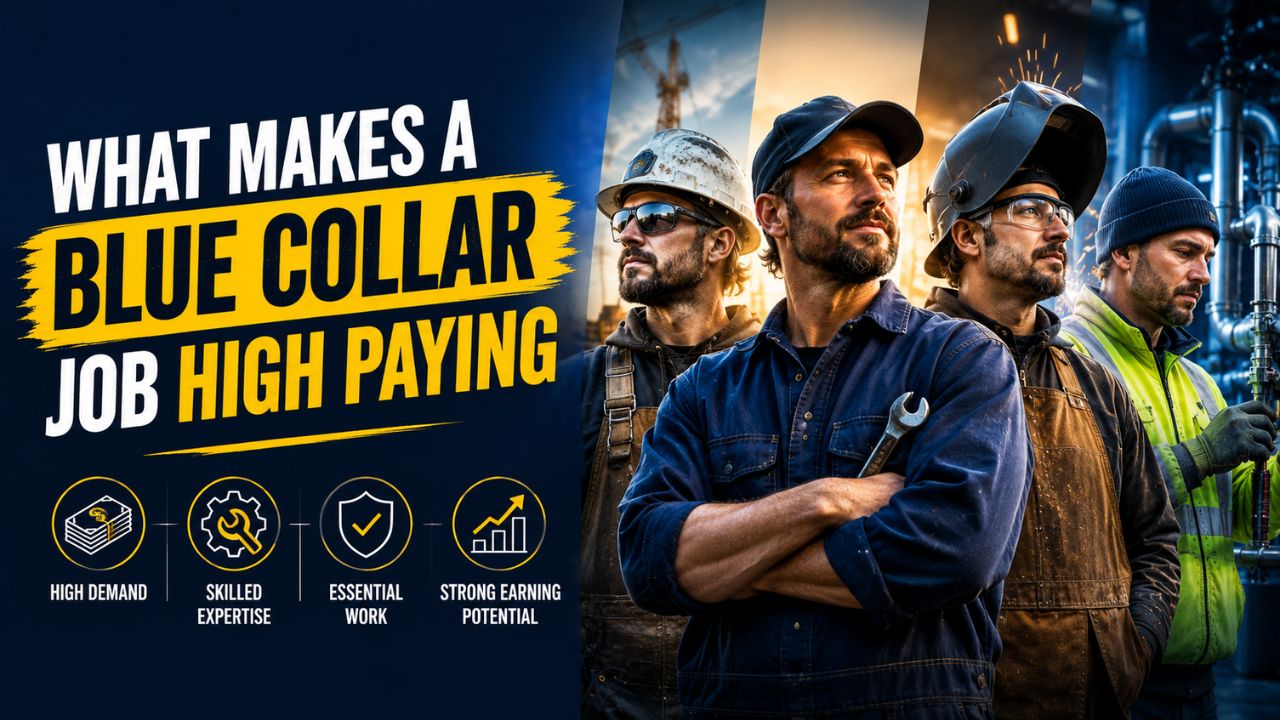
What Makes a Blue Collar Job High Paying?
Not every trade pays the same. The biggest factors that push a blue collar salary higher are:
Specialization. The more technical and specific the skill set, the harder it is to replace. Pipe welders, elevator mechanics, and radiation technicians earn more because fewer people can do the job.
Physical risk. Jobs like lineman work, commercial diving, and ironwork carry real physical hazards. Pay reflects this.
Licensing and certification. Trades that require ongoing re-certification and formal licenses tend to have higher pay floors because the barrier to entry is real.
Union membership. Union workers in trades like electrical, plumbing, ironwork, and elevator installation consistently earn more than non-union workers in the same fields.
Geographic demand. A licensed electrician in a booming construction market earns more than the same person in a low-demand area. Urban markets and resource-heavy regions often pay at the top of the scale.
How to Get Into a High Paying Blue Collar Career
Start With an Apprenticeship
Apprenticeships are the most reliable path into the highest paying blue collar jobs. Most are sponsored by unions or industry associations and combine paid on-the-job training with classroom instruction. You earn while you learn, which means no student debt.
In the US, the Department of Labor’s Apprenticeship.gov database lists registered programs by trade and location. In Canada, provincial apprenticeship offices coordinate similar programs. In the UK, government-backed apprenticeship schemes cover most skilled trades. In Australia, Australian Apprenticeships connects prospective tradespeople with employers and training providers.
Consider Vocational School First
For trades that require foundational technical knowledge (HVAC, welding, plumbing basics), a vocational school program of six to eighteen months can accelerate entry into an apprenticeship or direct employment. Community colleges in the US often offer these programs at very low cost.
Get Licensed and Stay Licensed
Licensing matters in the highest paying trades. A master electrician license, a journeyman plumber certification, or an FAA airframe and powerplant certificate are not just formalities. They are the credentials that unlock the top pay tier in each field. Keeping licenses current with continuing education protects that earning power.
Work Your Way Into Specializations
The fastest path to a six-figure blue collar salary is specialization. Once you have your base trade credentials, identify the highest-value niche within your field. For electricians, that might be data center or industrial work. For welders, it is pipe welding on energy infrastructure. For HVAC techs, it is commercial refrigeration or industrial systems.
Frequently Asked Questions
What is the highest paying blue collar job?
The highest paying blue collar jobs in 2026 are elevator installer and repairer, power line technician, and industrial pipefitter, all of which average between $85,000 and $130,000 per year. Commercial divers and offshore radiation technicians can earn above $150,000 with experience and specialized certification.
Can you make $100K in a blue collar job without a degree?
Yes. Elevator installers, linemen, industrial pipefitters, and master electricians regularly earn over $100,000 per year without a four-year college degree. Most reach that income level through apprenticeships and accumulated experience rather than formal university education.
Are blue collar jobs in demand in 2026?
Yes. The skilled trades shortage is growing across the US, UK, Canada, and Australia. Retirements in the trade workforce are outpacing new entrants, and growing infrastructure investment is increasing demand. Most high paying blue collar trades are projected to see job growth through the end of the decade.
How long does it take to get a high paying blue collar job?
It varies by trade. Some roles, like truck driving and solar installation, can be entered within a few weeks to months of training. Most high-paying skilled trades, like electrician, plumber, and elevator installer, involve four to five-year apprenticeships. The financial payoff at the end of that training is typically much better than a four-year degree in many fields.
Are blue collar jobs good long term?
Yes. Blue collar jobs provide physical, on-site work that is difficult to automate or outsource. Trades like electrical work, plumbing, and HVAC require human judgment, physical dexterity, and on-site problem-solving that cannot be replaced by software or off-shored to another country. This gives skilled tradespeople a degree of job security that many white-collar workers do not have.
Conclusion
The idea that blue collar means low pay is outdated. In 2026, the highest paying blue collar jobs offer competitive salaries, genuine job security, and career paths that do not require six-figure student debt to enter. Elevator installers, linemen, pipefitters, and master electricians are earning what many office professionals earn, and often with better union protections and retirement benefits.
If you are considering a career change, thinking about your first career, or looking for a path to a better income, skilled trades are worth a serious look. Start by researching apprenticeship programs in your area, contact your local union hall, or look up vocational programs at a nearby community college.
The work is real, the demand is strong, and the pay is better than many people expect. That combination is hard to find anywhere in today’s job market.