 SENSE INSIDER Personal Finance, Smart Investing, Passive Income and Side Hustle & Budgeting Tips
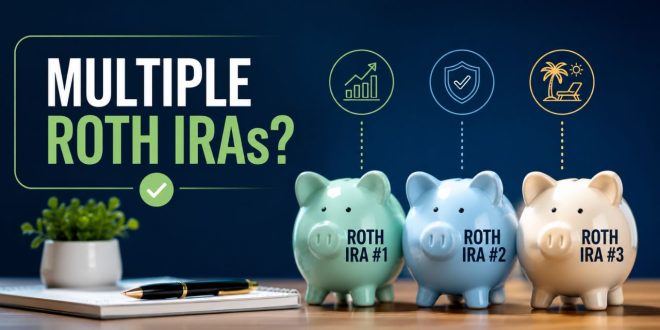
If you’ve been building your retirement savings and wondering whether you can spread your money across more than one Roth IRA, you’re not alone. It’s one of the most common questions people ask when they start getting serious about investing for retirement. And the short answer is yes, you absolutely can have multiple Roth IRAs.
But here’s the part that trips most people up: having more than one account doesn’t mean you can contribute more money. The IRS contribution limits apply to your total Roth IRA contributions across all accounts, not to each account individually. If you miss that detail, you could end up with a tax headache that takes years to untangle.
In this guide, you’ll learn exactly how multiple Roth IRAs work under the 2026 rules, what the IRS allows and what it doesn’t, how to combine a Roth IRA with a Traditional IRA, and whether having more than one account actually makes strategic sense for your financial situation. Whether you’re just starting out or you’ve been investing for years and want to optimize your setup, this covers everything you need to know.
How Many Roth IRAs Can You Have? The IRS Answer
There is no legal limit on how many Roth IRA accounts you can open. The IRS does not place a cap on the number of accounts. You could technically open a Roth IRA at Fidelity, another at Vanguard, a third at Charles Schwab, and a fourth at a local credit union if you wanted to. All of that is completely legal.
What the IRS does limit is how much money you can put into all of those accounts combined in a single tax year.
For 2026, the Roth IRA contribution limit is $7,000 per year if you’re under age 50. If you’re 50 or older, you can contribute an additional $1,000 catch-up contribution, bringing your total to $8,000. That $7,000 (or $8,000) is the maximum across all of your Roth IRAs added together, regardless of how many accounts you have.
So if you have two Roth IRAs and you put $4,000 into one, you can only put $3,000 into the other. The total still has to stay at or below $7,000 for the year.
If you exceed that limit, the IRS charges a 6% excise tax on the excess contribution for each year the excess remains in the account. That penalty compounds until you either withdraw the excess or offset it with a reduced contribution the following year. The fix is manageable, but it’s better to avoid the problem in the first place.
Income Limits Matter Too
Before getting into strategy, it’s worth flagging income limits because they determine whether you can contribute to a Roth IRA at all.
For 2026, Roth IRA eligibility begins to phase out at the following income levels:
- Single filers: Phase-out begins at $150,000 in modified adjusted gross income (MAGI) and ends at $165,000
- Married filing jointly: Phase-out begins at $236,000 and ends at $246,000
- Married filing separately (and you lived with your spouse at any point): Phase-out starts at $0 and ends at $10,000
If your income is above the upper limit, you cannot contribute directly to a Roth IRA. (You may still be able to use a “backdoor Roth IRA” strategy, which involves contributing to a Traditional IRA and then converting it, though this has its own nuances worth discussing with a financial advisor.)
Why Would You Want More Than One Roth IRA?
This is a fair question. If the contribution limit is the same regardless of how many accounts you have, why bother with multiple accounts at all?
There are actually several good reasons people choose to maintain more than one Roth IRA, and some of them are genuinely worth considering depending on your situation.
Access to Different Investment Options
Not every brokerage offers the same investments. Vanguard is well known for its low-cost index funds. Fidelity offers zero-expense-ratio funds and fractional shares. A self-directed IRA custodian might let you hold real estate or private equity. If you want access to a specific investment that isn’t available at your current brokerage, opening a second Roth IRA at another institution is a straightforward way to get it.
Separating Inherited IRAs
If you inherit a Roth IRA from someone who wasn’t your spouse, IRS rules require that inherited IRA to be kept in a separate account. It cannot be commingled with your own Roth IRA. So if you already have your own Roth IRA and you inherit one, you will automatically have multiple accounts regardless of whether you planned for it.
Organizational Strategy
Some people keep separate Roth IRAs for different purposes. One account might be earmarked for long-term retirement growth using aggressive index funds. Another might hold more conservative investments closer to retirement. While you can accomplish the same thing within a single account using asset allocation, some investors find it easier to think about their money when it’s separated by goal.
Taking Advantage of Promotions or Better Features
Brokerages occasionally offer sign-up bonuses, improved tools, or new account features that make opening a second account worthwhile. If a competing platform offers significantly better research tools, lower fees on certain funds, or a cash bonus for transferring assets, that’s a legitimate reason to diversify across providers.

Can You Have a Traditional and Roth IRA at the Same Time?
Yes, you can have both a Traditional IRA and a Roth IRA. This is one of the most common setups for retirement savers, and the IRS explicitly allows it.
The rules around combining them are straightforward but important to understand. The combined contribution limit across all of your IRAs, both Traditional and Roth, is still $7,000 per year ($8,000 if you’re 50 or older). So you can split your contributions between the two account types however you like, as long as you don’t exceed the total limit.
For example, you could contribute $3,500 to your Traditional IRA and $3,500 to your Roth IRA. Or $1,000 to Traditional and $6,000 to Roth. Any combination works, as long as the total stays at or below $7,000.
When Having Both Makes Sense
The core strategic reason to have both types comes down to tax diversification. With a Traditional IRA, your contributions may be tax-deductible now (depending on your income and whether you have access to a workplace retirement plan), but you’ll owe income taxes when you withdraw in retirement. With a Roth IRA, you contribute after-tax dollars, but qualified withdrawals in retirement are completely tax-free.
If you’re not sure what tax bracket you’ll be in during retirement, having money in both types of accounts gives you flexibility. You can draw from the account that makes the most tax sense in any given year. That’s a genuinely valuable option to have.
It’s worth noting that if you also have access to a 401(k) or similar workplace plan, having Traditional and Roth IRA accounts on top of that further expands your tax diversification. Many financial planners specifically recommend this kind of layered approach for people who can afford to make full contributions.
Managing Multiple Roth IRAs Without Making Mistakes
Opening multiple accounts is legal and can be strategic, but it also introduces complexity. Here’s how to stay organized and avoid common errors.
Track Your Total Contributions Carefully
This is the single most important habit for anyone with more than one IRA. Keep a running tally of how much you’ve contributed across all accounts in the current tax year. A simple spreadsheet works. Many brokerage platforms also let you set contribution tracking alerts. Whatever method you use, make it a regular check rather than a year-end scramble.
Remember: the contribution deadline for IRAs is Tax Day each year (typically April 15). Contributions for the prior tax year can be made all the way up to that deadline, which means you could be making contributions for two different tax years in the same calendar month. That’s another reason clear tracking matters.
Consolidating May Make Things Simpler
If you find yourself with multiple Roth IRAs scattered across different institutions and you’re not getting any specific benefit from keeping them separate, consolidating into one account is worth considering. You can do this through a tax-free direct rollover (also called a trustee-to-trustee transfer). The money moves from one institution to another without passing through your hands, which means there’s no tax event and no 60-day rollover window to worry about.
Consolidating simplifies your paperwork, makes contribution tracking easier, and reduces the chance of losing track of an old account.
Be Careful With Rollovers
There’s an important rule that catches some people off guard: the one-rollover-per-year rule. If you take an indirect rollover (meaning the money is distributed to you personally and then you re-deposit it into another IRA within 60 days), you can only do that once across all of your IRAs within a 12-month period. Violating this rule results in the distribution being treated as a taxable withdrawal, potentially triggering both income taxes and a 10% early withdrawal penalty.
Direct rollovers between institutions don’t count against this limit, which is another reason why trustee-to-trustee transfers are the cleaner option.
If you want to better understand how to make your money work harder as you build toward financial independence, take a look at our guide on how to invest money as a teenager at Sense Insider. While it’s aimed at young investors, the foundational principles around long-term wealth building apply at any age.
Roth IRA Rules in 2026: The Full Picture
A lot has stayed consistent with Roth IRA rules over the years, but it’s worth laying out the full 2026 picture in one place.
Contribution limit: $7,000 per year if you’re under 50, $8,000 if you’re 50 or older. This applies to the total across all IRAs of any type.
Income eligibility (Roth IRA): You must have earned income equal to or greater than your contribution amount. Investment income, Social Security benefits, and pension payments do not count as earned income for this purpose.
Income phase-out: As covered above, full contributions are available up to $150,000 MAGI for single filers and $236,000 for married filing jointly. Partial contributions are allowed in the phase-out range.
Qualified withdrawal rules: To take tax-free withdrawals from a Roth IRA, the account must be at least 5 years old, and you must be 59 and a half or older, permanently disabled, or withdrawing up to $10,000 for a first home purchase.
No required minimum distributions: Unlike Traditional IRAs, Roth IRAs do not require you to take distributions during your lifetime. This makes them particularly attractive for estate planning purposes, since you can let the money compound indefinitely.
Contribution deadline: April 15 of the following year. You can contribute to your 2026 Roth IRA any time from January 1, 2026 through April 15, 2027.
How Many IRAs Can You Have? Understanding the Full IRA Landscape
When people ask how many IRAs they can have, they’re sometimes surprised to learn that there are several types of IRAs, and the rules vary a bit across them.
Beyond Traditional and Roth IRAs, self-employed people and small business owners also have access to SEP IRAs (Simplified Employee Pension IRAs) and SIMPLE IRAs. These work differently: they have higher contribution limits (a SEP IRA allows contributions up to 25% of compensation or $69,000 in 2026, whichever is less), and contributions come from the employer side rather than the individual.
Crucially, SEP IRA contributions do not count against your $7,000 Traditional or Roth IRA limit. They operate under separate limits entirely. So if you’re self-employed and making SEP IRA contributions, you can still fully fund a Roth IRA on top of that, as long as you meet the income requirements.
Here’s a quick summary of what’s possible:
- You can have multiple Roth IRAs (no limit on account count)
- You can have multiple Traditional IRAs (no limit on account count)
- You can have both a Roth and Traditional IRA simultaneously
- You can have a SEP or SIMPLE IRA on top of the above
- Combined Traditional + Roth IRA contributions cannot exceed $7,000/$8,000 per year
- SEP and SIMPLE IRA contributions operate under separate, higher limits
For freelancers, side hustlers, and self-employed professionals building wealth outside of traditional employment, this combination of account types can be remarkably powerful. If you’re generating extra income from a side hustle and wondering how to put it to work, our guide to how to make $1,000 fast from home covers legitimate income-generating strategies that could directly fund those IRA contributions.
Frequently Asked Questions
Can you have multiple Roth IRAs?
Yes. There is no IRS limit on the number of Roth IRA accounts you can have. You can open accounts at multiple brokerages simultaneously. However, the total amount you contribute across all Roth IRAs combined cannot exceed $7,000 per year ($8,000 if you’re 50 or older) for 2026.
Can you have more than one Roth IRA with different brokerages?
Absolutely. Many investors hold Roth IRAs at two or more institutions to access different investment options, take advantage of sign-up promotions, or simply because they opened new accounts over time. There’s no requirement to consolidate them unless you want to simplify your finances.
Does having two Roth IRAs double my contribution limit?
No. The contribution limit applies to the total amount you contribute across all Roth IRAs, not to each account individually. Two accounts with a $7,000 combined limit is the same as one account with a $7,000 limit. Having more accounts does not give you more contribution room.
Can I have a Roth IRA and a 401(k) at the same time?
Yes, and this is one of the most common and recommended retirement setups. A 401(k) has its own contribution limits (up to $23,500 in 2026 for employee contributions), completely separate from IRA limits. Having both allows you to save significantly more per year while also diversifying your tax treatment across pre-tax and post-tax accounts.
What happens if I contribute too much to my Roth IRAs?
The IRS charges a 6% excise tax on excess contributions for each year the money remains in the account. To fix the problem, you can withdraw the excess contribution plus any earnings on it before the tax filing deadline for that year, or you can apply the excess as a contribution to the following year (as long as it doesn’t cause you to exceed the limit in that year as well). Acting quickly limits how much the penalty compounds.
Final Thoughts: Is Having Multiple Roth IRAs Right for You?
Having more than one Roth IRA isn’t inherently better or worse than having just one. The right answer depends on your specific financial situation, what investments you want access to, and how comfortable you are managing multiple accounts.
If you’re already maxing out a single Roth IRA and want access to a broader range of investments, opening a second account at a different brokerage is a reasonable move. If you’ve inherited a Roth IRA, you may have no choice but to maintain separate accounts. If you’re a freelancer or self-employed professional, layering a Roth IRA on top of a SEP IRA can dramatically accelerate your retirement savings.
What matters most, regardless of how many accounts you have, is staying within the contribution limits, tracking your total contributions carefully, and keeping your long-term retirement goals in front of you.
The rules are flexible enough to let you build the retirement account structure that actually fits your life. The key is understanding the limits so you can work confidently within them.
If you’re still working on building the income to fund those contributions, Sense Insider has practical guides across personal finance, investing, and wealth-building strategies to help you get there. Start exploring the Investing and Wealth Building and Taxes and Financial Planning sections for resources that fit wherever you are in your financial journey.
Disclaimer: This article is for informational purposes only and does not constitute financial, tax, or legal advice. IRS rules and contribution limits are subject to change. Consult a qualified financial advisor or tax professional for guidance specific to your situation.