 SENSE INSIDER Personal Finance, Smart Investing, Passive Income and Side Hustle & Budgeting Tips
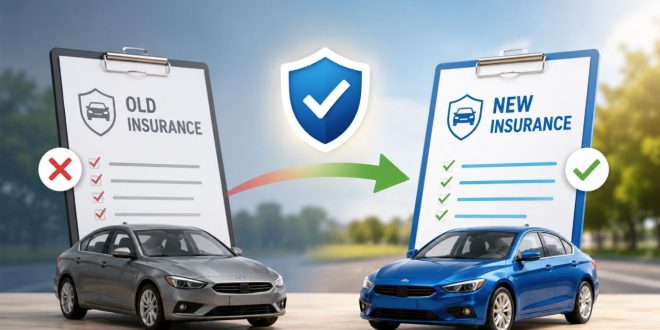
You are paying too much for car insurance. Maybe your renewal notice just landed with a bigger number than last year. Maybe a friend mentioned they slashed their premium by switching providers. Or maybe you have just had one too many frustrating calls with your current insurer and you are done.
Whatever the reason, the good news is this: switching car insurance is easier than most people think, and you can do it at almost any point in your policy. You do not have to wait until renewal, you will not automatically get penalized, and if you do it right, you will not have a single day without coverage.
In this guide, you will learn exactly how to switch car insurance step by step, what to watch out for (including a common mistake that can cost you hundreds), and when the timing actually matters. Whether you are in the USA, UK, Canada, or Australia, the core process is the same.
Can You Switch Car Insurance at Any Time?
Yes. You can switch car insurance at any time during your policy period, not just at renewal. Most insurance companies allow mid-policy cancellations, and many will even refund the unused portion of your premium.
That said, a few things determine whether switching mid-term makes financial sense:
Cancellation fees: Some insurers charge a flat fee or a percentage of your remaining premium for early cancellation. In the UK, this is common. In the US and Canada, policies more often allow free cancellation with a pro-rata refund.
Short-rate vs. pro-rata refunds: A pro-rata refund gives you back the exact amount for the unused days. A short-rate refund takes a small penalty out of what you would otherwise receive. Always ask which method your insurer uses before you cancel.
New policy start date: Your new policy must start the day your old one ends or the day you cancel, whichever comes first. Even one day without coverage can create problems.
The bottom line: yes, you can change your auto insurance any time, but check the fine print on fees and refunds first.
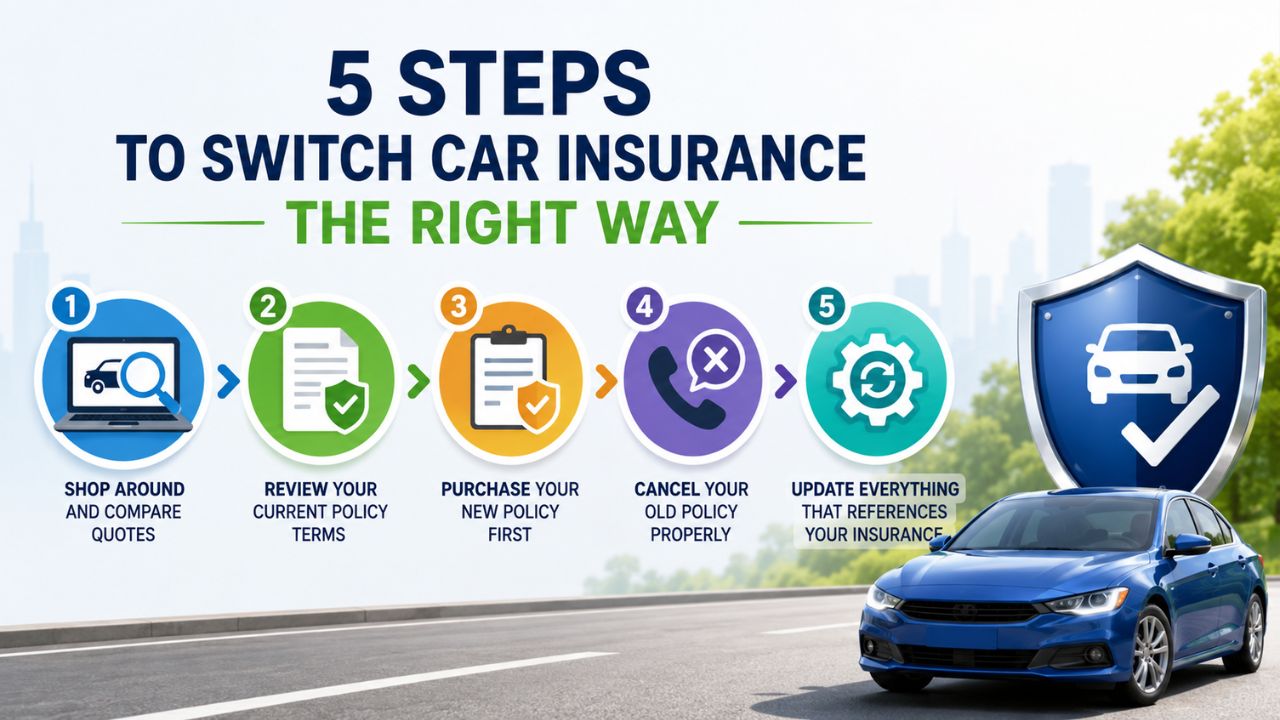
5 Steps to Switch Car Insurance the Right Way
Step 1: Shop Around and Compare Quotes
Before you cancel anything, get competing quotes. This sounds obvious, but a lot of people cancel first and shop second, which puts unnecessary pressure on the process.
When gathering quotes, compare apples to apples. Make sure each quote covers the same:
- Liability limits (e.g., 100/300/100 in the US, third-party or comprehensive in the UK/Australia)
- Deductible or excess amount
- Collision and comprehensive coverage if applicable
- Any add-ons you currently have, like roadside assistance or rental reimbursement
Use at least three to five comparison sites or direct insurer websites. In the US, popular options include Progressive, GEICO, State Farm, and USAA for military members. In the UK, sites like Compare the Market and MoneySuperMarket do a lot of the legwork for you. In Canada, try Kanetix or Ratehub.
Do not just chase the cheapest number. Read what is actually included. A policy that costs $50 less per month but carries a $2,000 higher deductible is not necessarily a better deal.
Step 2: Review Your Current Policy Terms
Pull out your current policy document and look for two things specifically.
First, find the cancellation clause. Does your insurer charge a fee for early cancellation? Is the refund pro-rata or short-rate? Is there a minimum notice period, such as 14 or 30 days?
Second, look at your renewal date. If you are within 30 to 60 days of renewal, you might save yourself hassle by simply not renewing rather than canceling mid-term. However, if your new policy offers significant savings and your current insurer uses pro-rata refunds with no cancellation fees, switching immediately makes sense.
Also take a moment to note your current coverage limits. You want your new policy to match or exceed them. Downgrading coverage to save money is a temptation, but it can backfire badly when you actually need to file a claim.
Step 3: Purchase Your New Policy First
This is the most important rule in the whole process: buy your new policy before you cancel the old one.
Never cancel your existing coverage and then shop around. Even 24 hours without insurance can create a lapse in coverage, which insurance companies can see on your record. A lapse, even a brief one, can label you as a higher-risk driver and push your premiums up when you try to get insured again.
When you purchase the new policy, set the start date for the same day you plan to cancel the old one. If you want to be extra safe, set it one day earlier and allow for a brief overlap. The small cost of one overlapping day is worth the peace of mind.
Also keep your insurance ID card or digital proof handy the moment your new policy activates. You do not want to be driving around with the wrong card in your glove box.
Step 4: Cancel Your Old Policy Properly
Once your new policy is active, contact your old insurer to cancel.
In most cases, you will need to do this by phone or in writing. Some insurers now allow online cancellations, but it is worth calling to confirm everything is processed and to ask about your refund.
When you call, have these details ready:
- Your policy number
- The cancellation date (should match your new policy start date)
- Your preferred refund method
Ask for a written confirmation of cancellation. An email is fine. This is your proof that you ended the policy intentionally and on a specific date, which protects you if there is any billing dispute later.
Do not simply stop paying premiums and assume the policy will lapse. That creates a messy cancellation record and can result in the insurer sending the unpaid balance to collections.
Step 5: Update Everything That References Your Insurance
Switching car insurance is not fully complete until you update the relevant parties.
If you have a car loan or lease, your lender or leasing company is almost certainly required to be listed as a lienholder on your policy. Your new insurer will need their details, and you may need to notify the lender directly as well. Failing to do this can put you in breach of your loan agreement.
If your state or country requires proof of insurance for registration purposes, make sure your DMV or equivalent authority has your new information on file.
Finally, update your wallet. Toss the old insurance card and put the new one in its place. If you use a digital insurance app, remove the old policy and add the new one.
When Is the Best Time to Switch Car Insurance?
While you can change insurance companies at any point, there are a few situations where switching makes particular sense.
At renewal: This is the cleanest option. No cancellation fees, no refund calculations, no overlap. Your current policy simply ends and the new one begins. Start shopping 30 to 45 days before renewal so you have plenty of time to compare.
After a life change: Got married? Moved to a new zip code or postal code? Bought a new car? Added a teen driver? All of these trigger a rate recalculation anyway, making it a natural time to see if another insurer offers better terms for your new situation.
After a rate increase: If your insurer raises your premium at renewal without a clear reason tied to your own driving record, that is a signal to shop around. Rates vary significantly between providers, and loyalty does not always pay.
After improving your credit score: In countries where credit history affects premiums (including most US states), a meaningful credit score improvement can earn you noticeably lower rates with a different insurer.
Common Mistakes to Avoid When Changing Auto Insurance
People make the same handful of mistakes when switching car insurance. Here is how to avoid them.
Letting coverage lapse. As covered above, always have new coverage in place before canceling the old. Even a brief lapse can follow you.
Reducing coverage to save money. It is tempting to drop collision or lower your liability limits to get a lower quote, but the savings can be wiped out by a single accident. Make meaningful comparisons before changing what you are covered for.
Not asking about discounts. New insurers often have discounts that your current insurer either does not offer or never told you about. Ask about multi-car discounts, safe driver programs, bundling with home or renters insurance, telematics programs, low mileage discounts, and good student discounts if you have young drivers on the policy.
Ignoring the new insurer’s financial strength. Price matters, but so does whether the company will actually pay your claim efficiently. Look up ratings from AM Best (USA), the Financial Conduct Authority (UK), or equivalent bodies in Canada and Australia before committing.
Forgetting to return license plates. In some jurisdictions, like certain Canadian provinces, you need to hand in your plates before canceling. Check local requirements to avoid fines.
How Switching Car Insurance Affects Your Finances
Changing auto insurance is genuinely one of the faster ways to reduce a recurring household expense. The average American driver pays around $1,700 per year for full coverage, according to recent industry data, and studies consistently show that comparable coverage can vary by $500 to $1,000 or more between providers for the same driver profile.
If you find you can save $600 a year by switching, that is $50 a month going back into your budget. Redirected into a savings account or used to pay down debt, that adds up quickly.
On the flip side, if your current insurer has strong claims service, good app functionality, and you have never had issues, a slightly lower quote elsewhere may not be worth the administrative effort of switching. Factor in the full picture, not just the premium line.
For those who are also working on lowering other car-related costs, it is worth reading our guide on how to lower your car payment, which covers several strategies for reducing the overall cost of vehicle ownership.
What Happens to Your Claims History When You Switch?
Your claims history does not stay with your old insurer. It follows you.
Insurance companies in most countries share data through industry databases. In the US, that is CLUE (Comprehensive Loss Underwriting Exchange). In the UK, it is CUE (Claims and Underwriting Exchange). Your new insurer will pull this data when pricing your policy.
This means you cannot “reset” a bad claims history by switching. However, most claims only affect your premium for three to five years, so switching can still be worthwhile once that window passes.
It also means that if you have a clean record, you should not hide it. A spotless history is a bargaining chip. Some insurers specifically reward long-term clean drivers with their best rates.
Switching Car Insurance: USA, UK, Canada, and Australia
The core process of switching is universal, but a few country-specific details are worth knowing.
USA: Most states allow free cancellation with a pro-rata refund. Coverage requirements vary by state, with some states requiring only liability and others encouraging full coverage. Your insurer is required to give you advance notice before canceling on their end.
UK: Cancellation fees are standard here. The fee is often around 25 to 50 GBP, plus you may lose any no-claims discount for that policy year if you cancel mid-term. For this reason, UK drivers often benefit from timing the switch to renewal. The FCA requires insurers to be transparent about fees.
Canada: Auto insurance is provincially regulated, meaning the rules differ by province. In Ontario and Alberta, for example, coverage minimums and the refund process differ from British Columbia, where the government (ICBC) provides basic coverage that you cannot easily switch away from.
Australia: Comprehensive car insurance is optional but common. CTP (Compulsory Third Party) insurance is mandatory and state-specific. You can freely switch your comprehensive insurer at any time, but CTP operates differently by state.
FAQ: Switching Car Insurance
Can I change my car insurance before the policy period ends?
Yes. You can cancel your current policy at any point during the policy term. Many insurers will refund the unused premium. Check whether your policy uses a pro-rata refund (exact unused amount) or a short-rate refund (a small penalty deducted). Always activate your new policy before canceling the old one to avoid any coverage gap.
Will switching car insurance hurt my credit score?
Getting insurance quotes does not typically affect your credit score. Insurers in the US often use a soft credit pull (not a hard inquiry) when generating quotes. A soft pull does not appear on your credit report and does not lower your score. The act of canceling your old policy also does not impact your credit.
How soon can I switch after getting a new policy?
There is no mandatory waiting period. You can switch the day your current policy renews or cancel mid-term immediately after securing new coverage. The only practical consideration is timing your new policy’s start date to match the cancellation date of your old one.
Will I get a refund when I cancel my car insurance early?
In most cases, yes. The refund amount depends on how many days remain in your policy and whether your insurer uses pro-rata or short-rate calculations. Contact your insurer to confirm the exact amount before you cancel. Refunds are usually processed within 10 to 14 business days.
Does switching car insurance affect my no-claims bonus or discount?
In most countries, your no-claims bonus (NCB) or no-claims discount (NCD) is portable. You can take proof of your claims-free years to your new insurer, who should honor it when calculating your premium. Ask your current insurer for a proof of no-claims letter as part of your cancellation process.
Conclusion: Make the Switch and Keep More of Your Money
Knowing how to switch car insurance is one of those practical financial skills that most people learn late but benefit from quickly. The process takes a few hours at most: compare quotes, review your current terms, buy the new policy first, cancel the old one properly, and update your records. Done right, you maintain seamless coverage and potentially save hundreds of dollars, pounds, or dollars annually.
If your last renewal notice made you wince, that is your sign. Start comparing quotes today. You have nothing to lose and, quite possibly, a meaningful monthly saving to gain.
And while you are reviewing your car-related expenses, it is worth thinking about the full picture of vehicle costs. Check out our guide on what credit score you need to lease a car to see how your credit standing affects every part of car ownership, from insurance rates to financing terms.
The smartest money moves are the ones you make before you need them. Switching to better, cheaper car insurance is one of those moves.