 SENSE INSIDER Personal Finance, Smart Investing & Budgeting Tips
Picture this: you have some money sitting in a savings account earning almost nothing. You know investing is the smarter move, but every time you think about actually doing it, a wave of doubt hits you. What if you lose everything? What if you pick the wrong thing? What if you’re just not smart enough to figure this out?
Here is the truth: almost every successful investor started exactly where you are right now. They were confused, nervous, and convinced that investing was something only Wall Street professionals could understand. The difference between them and everyone else is not intelligence or luck. It is simply that they learned a handful of core principles and took that first step.
This guide is going to walk you through seven proven strategies to invest with confidence, whether you are a complete beginner, starting with a small amount of money, or someone who has tried before and got burned by fear. By the time you finish reading, you will know exactly what to do, why it works, and how to get started today.
What Does It Really Mean to Invest with Confidence?
Before diving into specific strategies, it helps to define what confidence in investing actually looks like. It does not mean being certain you will always make money. Even the most experienced investors lose money sometimes. True confidence in investing means understanding the basics well enough that you can make decisions without panic, stick to a plan during turbulent times, and trust the process over the long term.
The good news: confidence is learnable. You do not need a finance degree. You do not need a six-figure salary. You just need a clear framework and the willingness to start.
Strategy 1: Start with a Clear Financial Foundation
Why You Should Not Invest Before You Do This
One of the most common mistakes beginners make is jumping into the market before their personal finances are stable. If you have high-interest credit card debt or no emergency fund, investing before addressing those issues can actually put you in a worse position.
Here is a simple order of operations that financial experts in the USA, UK, Canada, and Australia consistently recommend:
- Pay off high-interest debt first (anything above 7-8% annually)
- Build an emergency fund covering 3 to 6 months of living expenses
- Then begin investing with money you will not need in the short term
This sequence matters because investing involves risk. Markets go up and down. If a market dip forces you to sell investments to cover an emergency, you lock in those losses. A solid cash cushion means you can weather short-term volatility without touching your portfolio.
Actionable tip: Open a dedicated savings account labeled “Emergency Fund” and automate a monthly transfer into it before you invest a single dollar. Once that fund hits your target, redirect that automatic transfer into an investment account.
Strategy 2: Understand the Power of Time in the Market
The Single Biggest Advantage You Have Right Now
If you are reading this guide, you still have time. And in investing, time is the most powerful tool available. This concept has a name: compound growth.
Here is a simple example. If you invest $200 per month starting at age 25, earning an average annual return of 7%, you will have approximately $525,000 by age 65. If you wait until age 35 to start with the same contributions, you end up with roughly $243,000. That 10-year delay costs you around $280,000, and you did not even contribute differently. Time did all the work.
The lesson here is not to stress about picking the perfect investment. The lesson is to start. Investing something today, even a small amount, beats waiting for the perfect moment because that moment rarely arrives on its own.
This principle also means you should not panic during market downturns. If your time horizon is 20 or 30 years, a bad year in the market is a small blip in a much larger story.
Strategy 3: Learn the Best Investment Strategies for Beginners Before You Buy Anything
Smart Investment Strategies That Reduce Risk From Day One
One of the most important investment tips for beginners is to understand what you are buying before you buy it. This does not mean you need to spend months studying. It means getting comfortable with a few core concepts.
Index Funds and ETFs
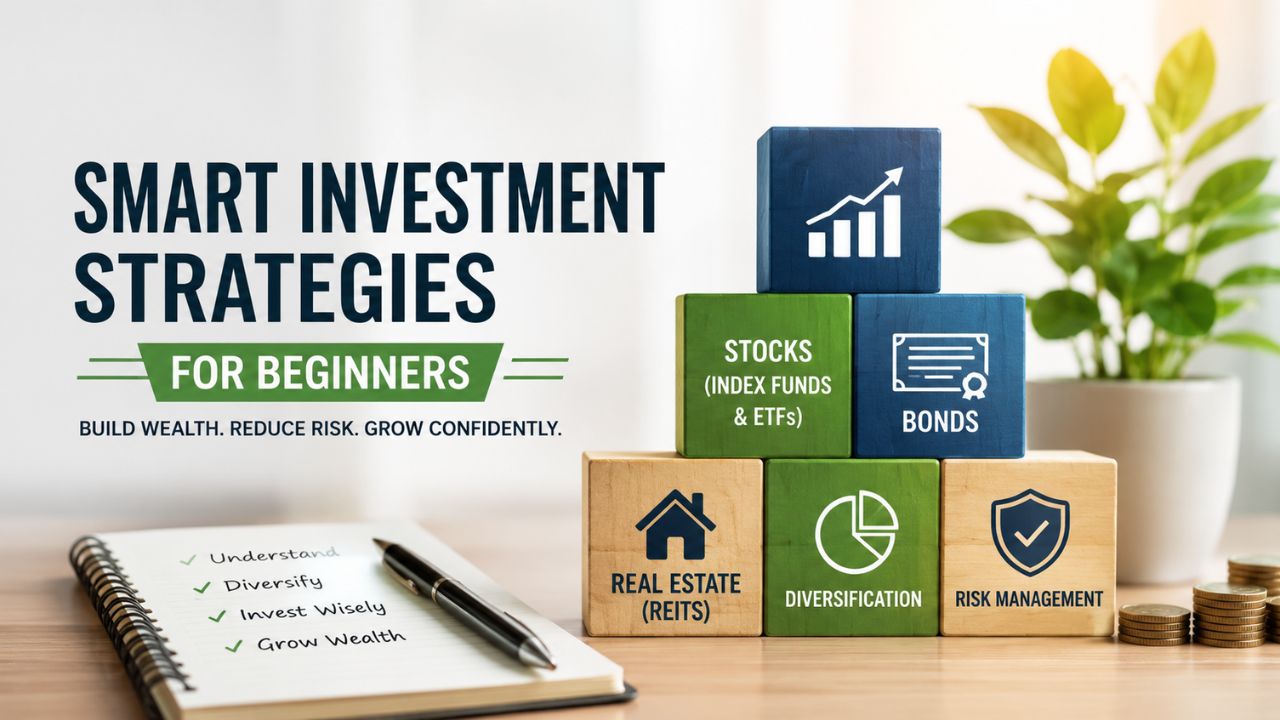
Index funds are widely considered the best investment strategy for beginners, and for good reason. Instead of picking individual stocks (which requires extensive research and carries higher risk), you buy a fund that automatically holds a tiny slice of hundreds or thousands of companies. When the overall market grows, your investment grows with it.
Exchange-traded funds (ETFs) work similarly but trade on the stock exchange like individual stocks, giving you more flexibility. Popular options in the USA include funds that track the S&P 500. Similar options exist in the UK (such as ISA-eligible ETFs), Canada (through TFSA accounts), and Australia (through the ASX).
Bonds and Fixed-Income Investments
For those with lower risk tolerance or shorter time horizons, bonds offer more stability than stocks. A bond is essentially a loan you give to a company or government in exchange for regular interest payments. Bonds generally deliver lower returns than stocks over the long run, but they add balance to a portfolio.
Real Estate Investment Trusts (REITs)
REITs let you invest in real estate without buying a property. They trade like stocks and are required by law to pay out most of their profits as dividends. They are an accessible option for building wealth through investing without the headaches of being a landlord.
Strategy 4: Diversify to Protect What You Build
How to Invest Money Wisely by Spreading Your Risk
You have probably heard the phrase “do not put all your eggs in one basket.” In investing, that principle is called diversification, and it is one of the most reliable tools for building a resilient portfolio.
Diversification means spreading your investments across different asset types, industries, and geographic regions. If one sector takes a hit, your other investments help cushion the blow.
Here is what a well-diversified beginner portfolio might look like:
- 60% in a broad stock market index fund (domestic)
- 20% in an international stock index fund
- 15% in bond funds
- 5% in a REIT or alternative asset
These percentages are not set in stone. They shift based on your age, goals, and risk tolerance. Younger investors can typically afford to hold more stocks because they have time to recover from downturns. Those closer to retirement often shift toward more bonds for stability.
The key takeaway: diversification does not guarantee profits, but it significantly reduces the risk of catastrophic loss from any single bad investment.
Strategy 5: How to Overcome Fear of Investing Through Consistent Action
Dollar-Cost Averaging: The Strategy That Removes Emotion from the Equation
Fear is the number one reason people do not invest, or stop investing during market dips. The market drops 10%, and suddenly every instinct says to sell and cut losses. But historically, pulling out of the market during downturns is one of the most expensive mistakes an investor can make.
One of the most effective ways to overcome fear of investing is a strategy called dollar-cost averaging (DCA). Here is how it works: instead of investing a lump sum all at once, you invest a fixed amount at regular intervals regardless of what the market is doing.
For example, you invest $150 every month. When the market is high, your $150 buys fewer shares. When the market dips, your $150 buys more shares at a discount. Over time, this averages out your cost per share and removes the pressure of trying to “time the market.”
Dollar-cost averaging is particularly powerful for beginners because it removes the emotional decision-making that leads to buying high and selling low. You automate the process, ignore the noise, and let time do its work.
Most investment platforms in the US, UK, Canada, and Australia allow you to set up automatic recurring investments, making this strategy almost effortless to maintain.

Strategy 6: How to Invest with Little Money (And Still Build Real Wealth)
Safe Investment Options for Beginners on a Tight Budget
A widespread myth is that you need a lot of money to start investing. This idea has kept millions of people on the sidelines for years. The reality is that you can begin with as little as $1 on many modern platforms.
Here are practical options for how to invest with little money:
Micro-investing apps: Platforms like Acorns (USA, Australia), Moneybox (UK), and Wealthsimple (Canada) allow you to start with spare change. They round up your everyday purchases and invest the difference automatically.
Fractional shares: Many brokerages now let you buy a fraction of a single share. This means you can invest in companies with high stock prices without needing to buy a whole share.
Employer-sponsored retirement accounts: If your employer offers a 401(k) in the USA, a workplace pension in the UK, a Group RRSP in Canada, or a superannuation fund in Australia, start contributing even a small percentage of your income. Many employers match contributions, which is essentially free money.
High-yield savings accounts and money market funds: While not technically investing in the traditional sense, these are low-risk ways to earn more than a standard savings account while you build your investment confidence.
The key principle here is the same: start now, start small, and increase contributions over time as your income grows. Consistency over years beats large one-time investments every time.
For more ideas on building multiple income streams while you grow your investment portfolio, check out our guide on passive income and side hustles.
Strategy 7: Build a Long-Term Mindset for Financial Freedom
Investing for Financial Freedom Requires Playing the Long Game
Every strategy in this guide points toward one thing: long-term thinking. Investing for financial freedom is not about getting rich quickly. It is about building a system that works quietly in the background for years, then decades.
Here are the mindset shifts that separate confident, successful investors from those who give up:
Focus on what you can control. You cannot control market returns, inflation, or global events. You can control how much you invest, how diversified your portfolio is, and whether you stay consistent. Direct your energy accordingly.
Revisit your portfolio, not obsessively. Checking your portfolio daily is a trap. Markets fluctuate constantly, and watching every move triggers emotional responses. A quarterly review is more than enough for most long-term investors.
Increase contributions as your income grows. Each time you get a raise, direct a portion of it into your investments before lifestyle inflation absorbs it. Even moving from 5% to 8% of your income invested can dramatically change your long-term outcome.
Understand what you know before investing. Every investor should take time to understand what to know before investing in any new asset: the risk level, the historical performance, the fees involved, and how it fits their overall plan. This habit builds genuine confidence rather than the false confidence that comes from hype or tips.
If you are working toward financial independence, our deep-dive into the Financial Independence and FIRE category covers the roadmaps used by people who retired decades early by staying disciplined with their investments.
Frequently Asked Questions
How much money do I need to start investing?
You can start with as little as $1 on many modern platforms. The amount matters far less than the habit of investing consistently. Even $25 or $50 a month, invested regularly over many years, adds up significantly due to compound growth. The best answer to how to start investing for beginners is simply: start with whatever you have today.
Is investing safe for beginners?
All investing involves some level of risk, but choosing diversified, low-cost index funds and holding them long term is considered one of the safest investment options for beginners. The risk of losing everything is very low when you are broadly diversified. The bigger risk for most people is not investing at all, because inflation quietly erodes the value of cash sitting in a low-interest account.
What is the best investment strategy for beginners?
For most beginners, a simple two-fund or three-fund portfolio of low-cost index funds is the best starting point. It requires minimal effort, has historically delivered strong returns over the long term, and avoids the trap of stock-picking or market timing. Pair this with consistent monthly contributions and a long time horizon, and you have one of the most effective smart investment strategies available to everyday people.
How do I know when to start investing?
The best time to start is after you have paid off high-interest debt and built a small emergency fund. Beyond that, there is no perfect moment. Markets will always have uncertainty. Waiting for conditions to feel “safe” often means waiting forever. The longer you wait, the more compound growth you miss out on.
Can I invest if I have a low income?
Absolutely. Building wealth through investing is not reserved for high earners. Micro-investing apps, fractional shares, and employer retirement accounts all make it possible to start with very little. The habit and the time horizon matter far more than the initial dollar amount.
Conclusion: Your First Step Toward Investing with Confidence
Investing does not require perfection. It does not require a large starting balance or a deep understanding of every financial instrument on the planet. What it requires is a clear foundation, a simple strategy, the patience to stay consistent, and the willingness to start.
You now have seven concrete strategies to invest with confidence:
- Build a financial foundation before you invest
- Harness the power of time through early action
- Learn the investment vehicles that work best for beginners
- Diversify to protect your portfolio from unnecessary risk
- Use dollar-cost averaging to remove emotion from the process
- Start with whatever you have, no matter how small
- Develop the long-term mindset that makes wealth building possible
The gap between where you are and financial freedom is not as wide as it feels. It is bridged one consistent contribution at a time.
Ready to take action? Start today by opening a free investment account, setting up a small automatic monthly contribution, and choosing a simple index fund. Future you will look back at this moment as the turning point.
Explore more expert guidance on growing your money at Sense Insider’s Investing and Wealth Building hub.
Disclaimer: This article is for informational and educational purposes only and does not constitute financial advice. Please consult a qualified financial advisor before making investment decisions.